
covid vax and conception rates
studying the czech study

back during the dark days covidian, there were a great many theories about the mRNA shots DBA “vaccines” and their effects on pregnancy.
there was also a large amount of advice for pregnant or planning to be pregnant women that was as strident as it was baseless.
the results raised many an eyebrow.
there was certainly a coordinated collapse of birth rates around the world and a lot of this trend smelled fishier than a gumbo shack dumpster after madri gras, but there was never really quite enough data to really do the analyses that seemed warranted.
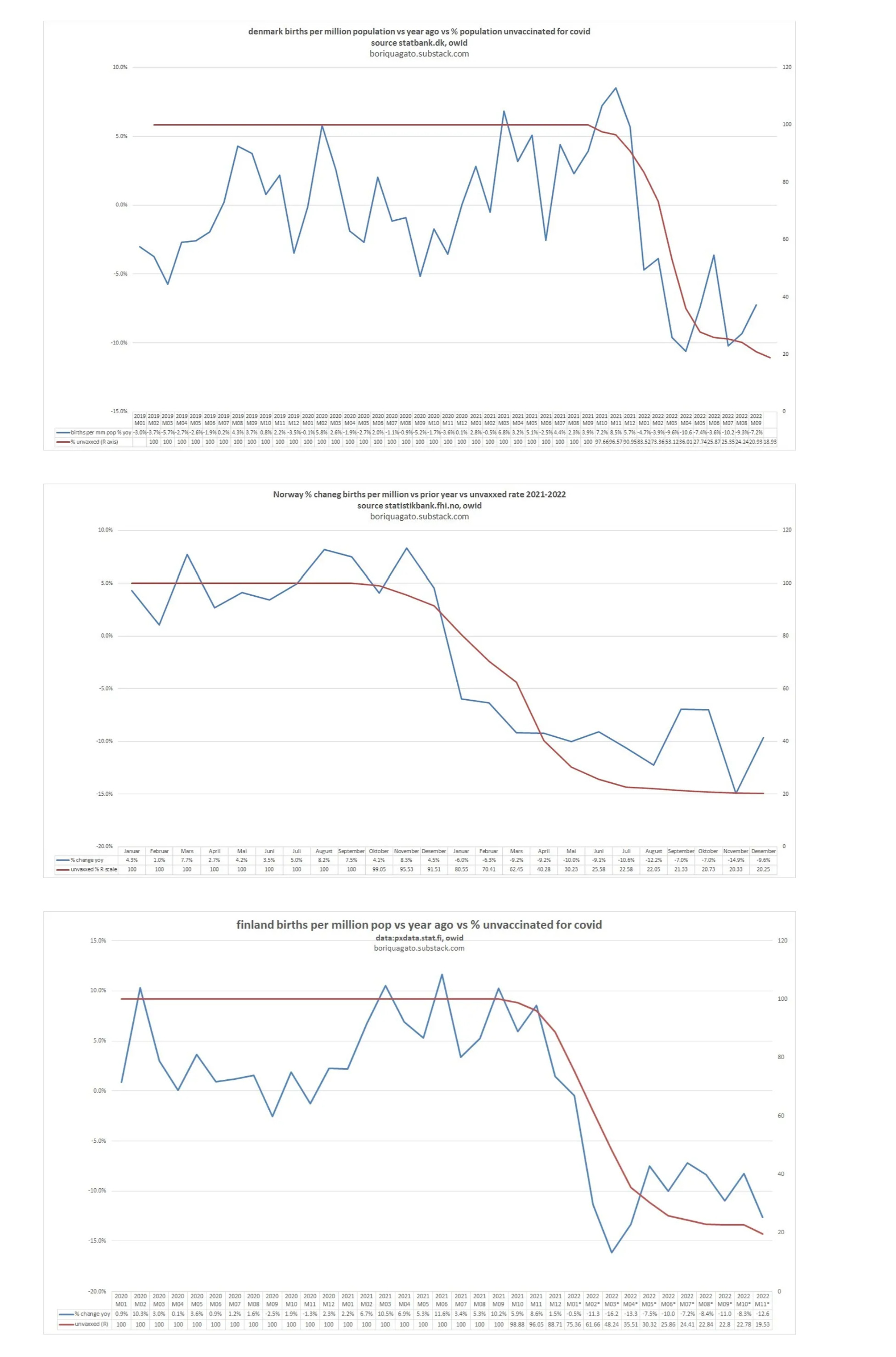
certain internet felines spent a fair but of time looking at sweden as a test case because they had very little in the way of lockdown or life disruption compared to most of the world and such as they had less possible interference.
the alignment of jabs rollout and natality collapse was very tight and highly provocative.

and this data replicated all across scandinavia and in many other places as well.
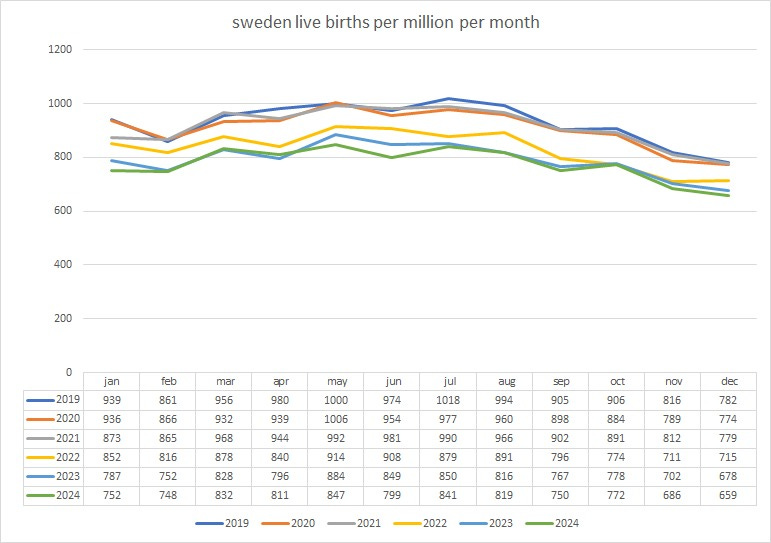
this has not recovered. swedish births had been stable for 3 prior years. they took a step function down in 2022 as the jabs piled up 9 month anniversaries, dropped again in 2023, and stabilized in 2024 at this new lower level which is 14% lower per million population.
that’s a large and durable drop.
in and among all of this rose the consistent frustration that the simple, clear data that one would really want to use to do this analysis and start to push past probable and/or “associated with” and into “proven” from a causal standpoint was never accessible. no one was making available the birth rate data by vaccination status.
well, now we have some.
it shows many of the same trends we’d expect if the mRNA jabs were suppressing live births and provides another line of independent evidence to help our causality mosaic. unfortunately, this STUDY also fails to reach dispositive gold standard level data quality for reasons i’ll dig into later, but it’s still highly compelling and can be made more so with a small addition.
let’s look:
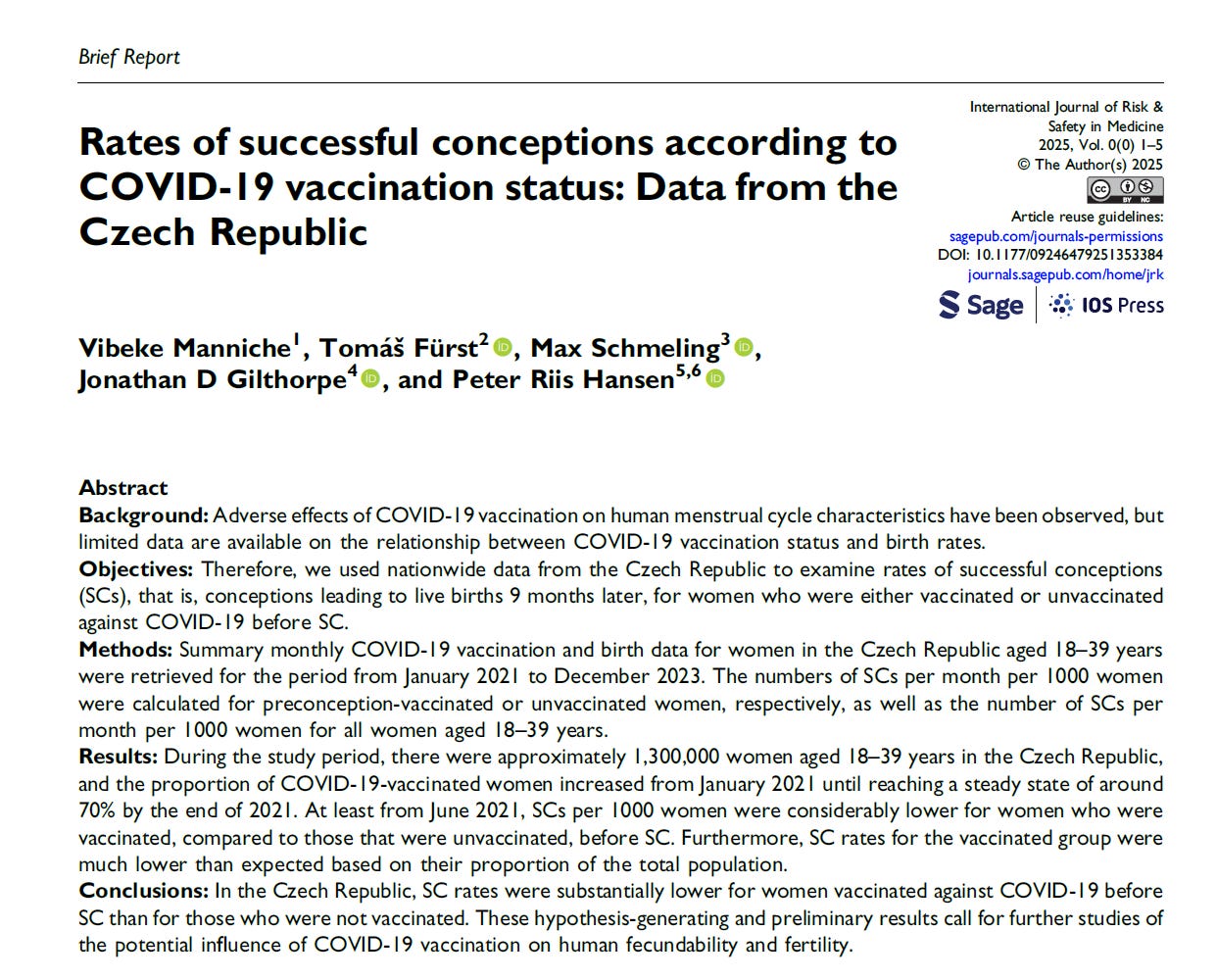
this is a peer reviewed publication and, interestingly enough, has a SAGE affiliation.
it tracked the 1.3 million czech women between the ages of 18 and 39 (peak fertility) and measured SC’s (successful conceptions defined as those resulting in a birth) and compared women who were vaccinated to those who were unvaccinated.
it’s a reasonable retrospective study structure.
the core finding was this:
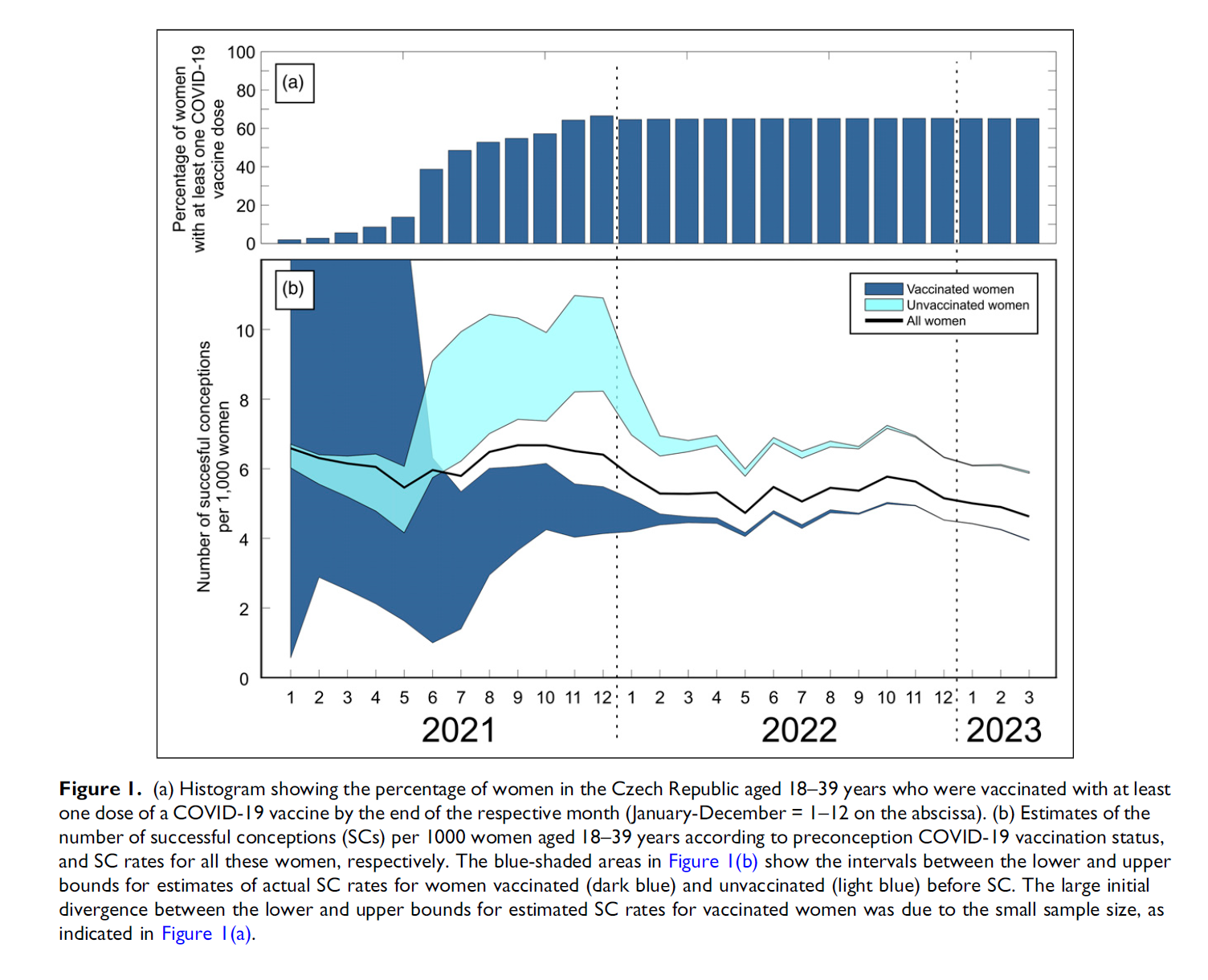
it’s a little tricky to read because what you’re seeing in the dark blue vs light blue funnels are collapsing error bars around vaccination status. it appears as though the two groups were probably pretty similar in terms of birth rates in early 2021, but there’s really no way to validate that from this data which is an issue that will rear its head in a minute.
what we can say is that once the error bars collapse and we have high certainty on vaxx status, we see enormous divergence between the two groups. the jabbed women are at about 4 births per 1000 and the unvaxxed are at 6, a full 50% higher. that is a massive variance and highly provocative.
note that the collapse comes at the same time as all these other countries. this phenomenon is widespread and synchronized.
unfortunately (and contrary to what some overzealous folks are wont to claim) this is not dispositive. the issue is that this is not an RCT. the cohorts of jabbed vs unjabbed are not random and are almost certainly subject to many kinds of selection bias related to age, health, race, religion, and even intent to have children. any one of those could be having a large effect on this outcome and the visible effect could easily be “all the highly religious people who have more kids did not get vaxxed” or perhaps immigrants or perhaps women planning to have babies got fewer jabs (or perhaps they got more and it’s made the effect look understated).
unfortunately, there is just no way to tell in a study like this and we do not even have cohort analysis to see if there are big variance by age, race, health, etc.
the authors (honorably and honestly) are very up front about this limitation.
they raise two interesting points, both of which i agree with:
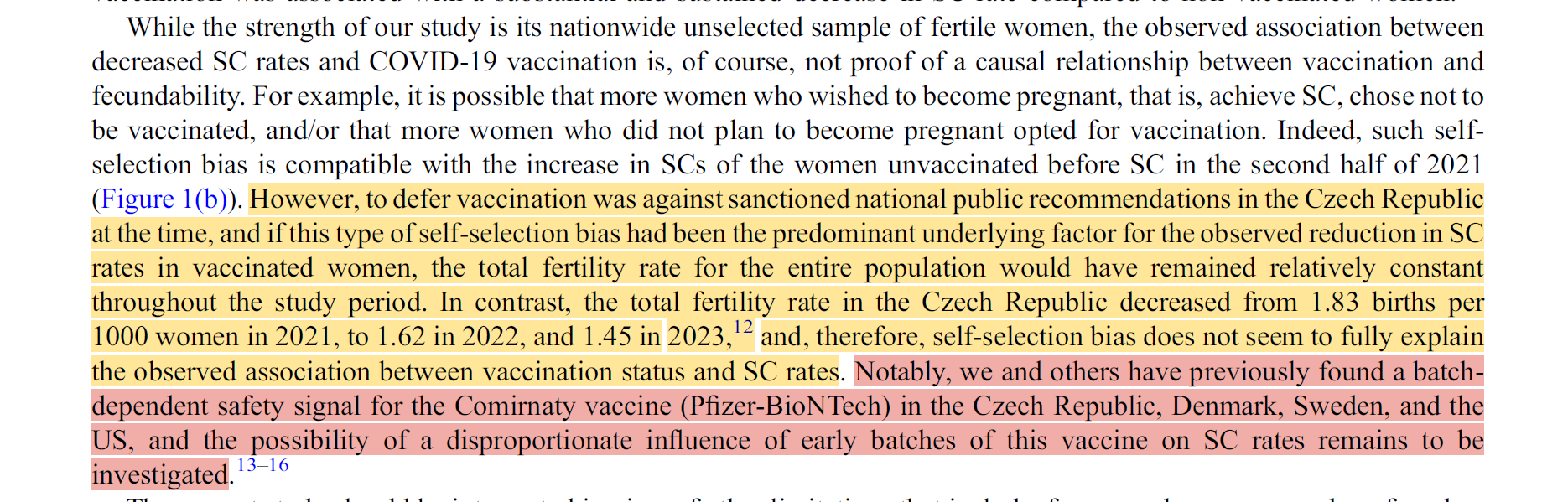
foremost, if this were just selection around “intent to get pregnant” it would have muted the effect of overall births, but overall births dropped.
making this more persuasive is how the numbers played out.
i added a red line to their chart to help show this.
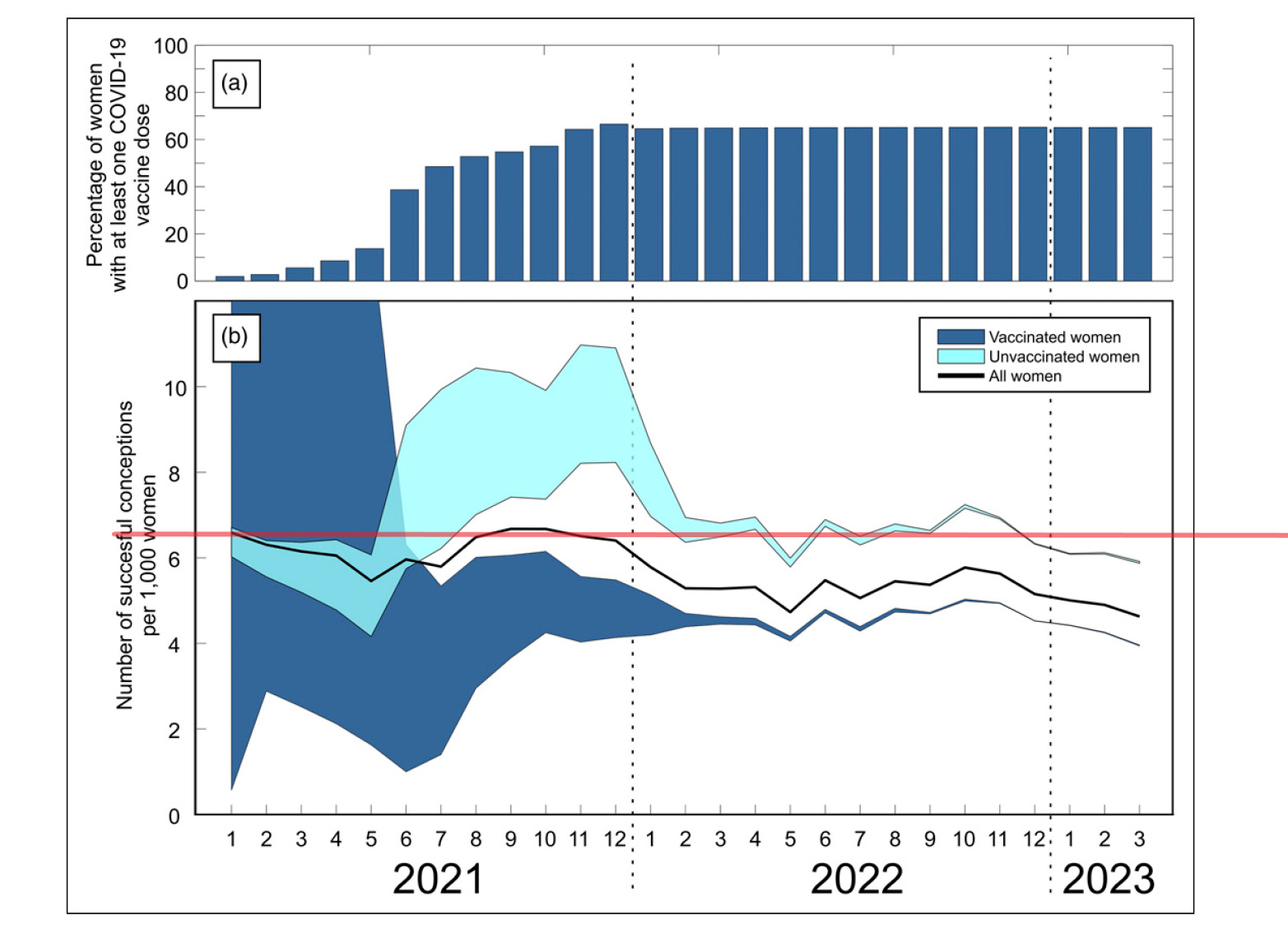
as you can see, the level of overall births (black line) was right about the level at which the unvaxxed births converged. the divergence from prior norm was all jabbed women.
to add a second pass check on this, i calculated births per 1000 czech women 18-39 for 2019 and 2020.
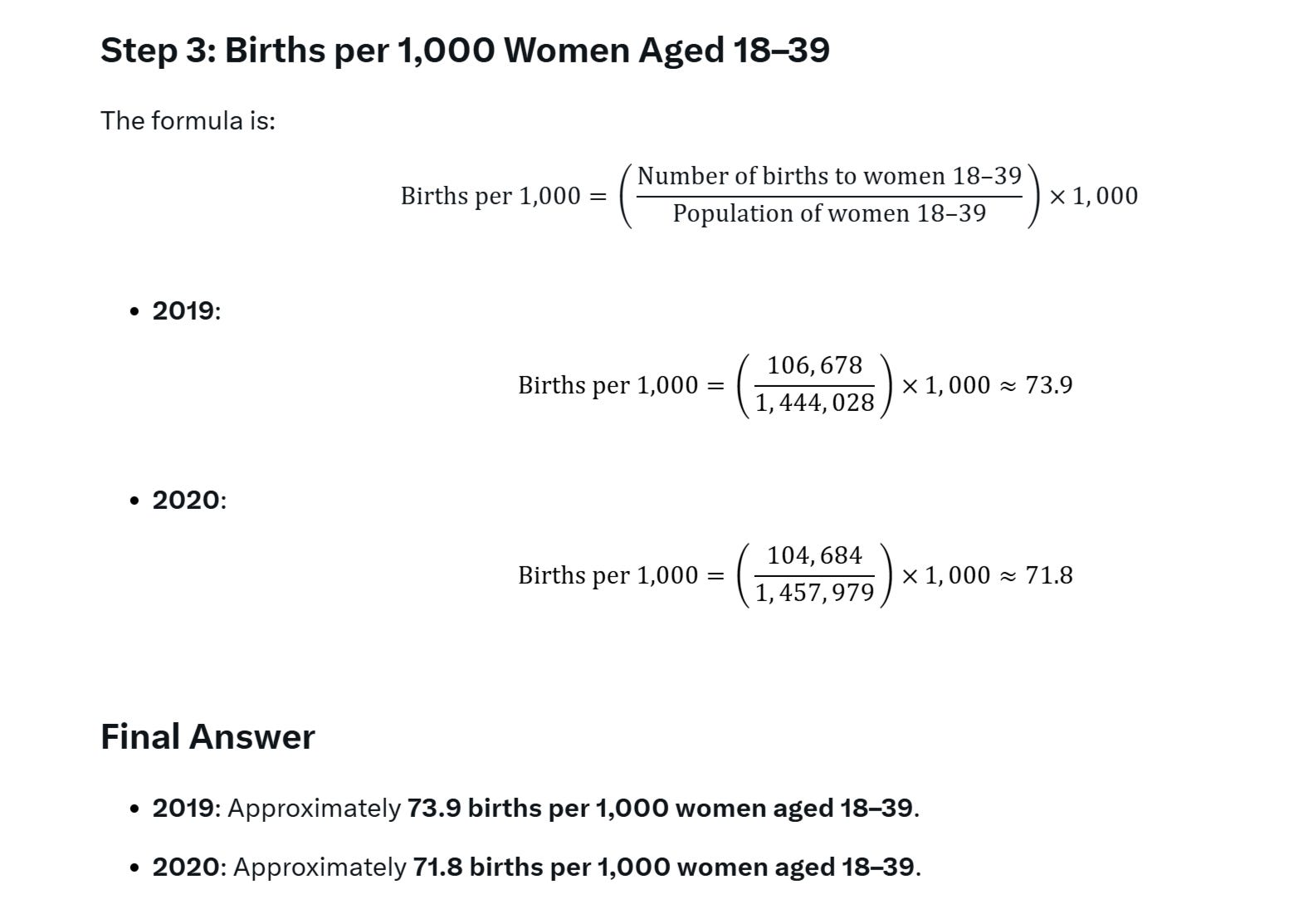
this is annual, so divide by 12 and you get 6.16 and 5.98 which perfectly and closely bracket where the unvaxxed wound up and where everyone began.
this adds some compelling evidence that the jab-free are pretty representative people whose base rate births are very much in line with the national average before the covidian crusades.
again, this is not absolute proof, but i think it rises to the level of “pretty fricking compelling” or even “wow you’d be stupid to ignore this.”

we could take this even further by paying attention to the author’s second point (in red above) that there appears to be a batch specific signal here on safety and that exploring it in pregnancy would be worthwhile.
on this i very much agree. if the drop in natality can be linked to specific batches injections and is absent in others, then we have pretty dispositive data because the batches were distributed fairly randomly.
i look forward to seeing what they find there. in general, you don’t make an allusion like that unless you have a pretty good idea what’s behind door number 3…
this would be a great project for the NIH.
the proof is in here somewhere.
my money is still on “we’ll find a smoking gun if we have the courage to look.”

Totally agree here. We can quibble with the exact implications of the study in question, but we should ALL agree the issue requires further investigation. And while we're at it, let's expand the scope beyond just birth rate and look into autoimmune disorders, or myocarditis, or........
While they look at birth rates between the vaxxed and unvaxxed they should also look at birth defects in each group. It’s going to be pretty sad in 10 years when you can look at some random 14 year old and know their mother was vaxxed during pregnancy.