
hard limits to soft power
and the rise and fall of empires

back in the long ago, when i was but a wee gatito and the earth was similarly green and young, there was a common retort to playground threats that one found non-credible:
“you and what army?”
hold on to that idea. it embeds a deep truth to which we shall return ere long (else the cat a liar call… <smirks puckishly>)
most are familiar with the idea of the rise and fall of empires expressed as a sort of simple encapsulation seemingly immutable since antiquity:
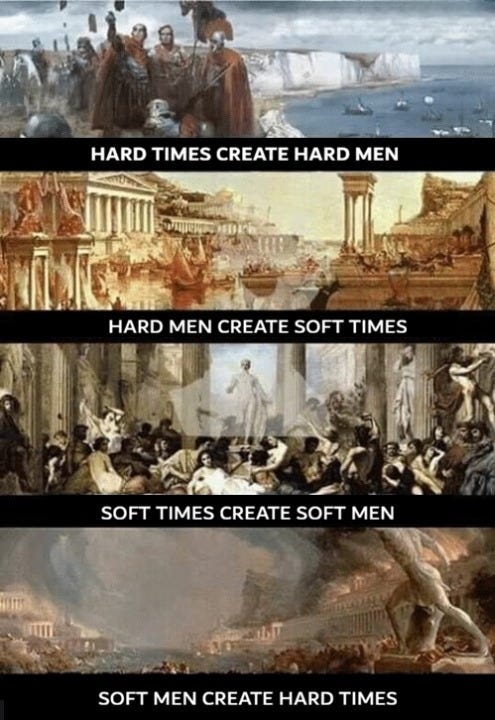
but i think perhaps overfew have considered the nature of power and how this comes to be. it gets cast as a sort of matter of forgotten virtue or lost valor as opposed to something a bit different which is “forgotten reality.” soft times are maligned, but the fact is that soft times are the best times. you want to live there. but all wants have limits and embed trade offs.
to explore this, let’s first set some definitions around types of power:
hard power is power to compel. its application is coercive and submission to it, when used effectively, is non-optional. it is violence and leverage and as such may only be resisted like to like. it is embodied in quotes like this: “government is not reason, it is not eloquence, it is force; like fire, a troublesome servant and a fearful master,” which outline the deep nature of authority and of the beast it may become.
soft power is power to convince. its application is volitional and submission to it voluntary, a matter of choice and conscience. it is, in effect, suasion, the generation of a set of ideas and memes that attract and sustain adherence of their own attractiveness. this is the power of golden ages, golden rules, and sustained non-defection in iterative prisoner’s dilemmas.
many like to pooh-pooh soft power as, well, soft and somehow inferior. but this is not at all the case. i would argue very much the opposite. soft power is the regime under which any right thinking and moral human wants to live. soft power is peace and prosperity, plenty and comfort, rights and social contracts. it’s basically everything you like about the world. a high functioning soft power civilization is, without question, the best of all possible civilizations in which to live.
the question is:
what does it take to keep it?
hard power is the other way. hard power is the fist, the assault, the robbery, the threat, the end of choice and the commencement of compulsion. it is war and warlords, rapine and plunder.
it’s not where you want to live.
but it’s always out there and if someone wants to go that way, then the question becomes:
how can you keep it at bay and prevent yourself from being conquered?
it is correct (and the basis of high trust systems) for hard power to serve soft power. it is correct for soft power to fear and even lament hard power. but when soft power starts to repudiate the idea of hard power, resent it and malign it as a problem, soft power becomes a suicidal enterprise, a lamb wandering within a wolf-woods and calling sheepish parents stupid.
this is what drives the cycle of soft and hard.
hard times require hard solutions. when one lives under predation and piracy, “rights” become a luxury and so does “peace.” you’d like to live that way but if sufficient of your neighbors do not, this choice is taken from you.
you seek to convince, they seek to compel, and those who bring words to a knife fight fare poorly and bleed out upon the ground while invaders take over their valleys and farms. that’s just immutable jungle law. its calculus cannot be changed. but it can be forgotten and i think this is where we get both into serious trouble and dangerous, rage inducing delusion.
we want to live in a soft system, a libertarian/social contract sort of system where the sanctity of our persons and property is protected by mutual agreement and respect by which each is, in turn, protected and bound, always both, never one or the other, for the two are reciprocals: my being bound by a contract to respect your property is the protection of your home and vice versa.
the hard part of such soft living is that one forgets how it came to be and what, of necessity, must underpin it. so accustomed to obedience to words become the residents of these golden ages that they begin to presume that the words themselves carry ultimate power. they come to presume that soft power alone may stand as the “speaking softly and carrying a big stick” that got us to here.
the denizens of such golden ages come to mistake their gilding as a sort of property of the world, a natural state as opposed to the profound and unusual (both geographically and historically) achievement that it is, a cultivation of rare blooms in a world of tearing brambles. the very success and seeming resilience of such systems makes them seem inevitable and the soft power under which they operate lies soft upon the citizens.
“free to choose” starts to look like a state of nature.
but it’s not and never can be.
such soft power societies protective of rights and agency tend to grow more permissive. “you be you, i’ll be me.” this a fine thing so long as everyone is a rights respecter and social contract follower. but when people start to abandon such ideas, defect in the iterative prisoners dillemma of high functioning soft power civilization, then of necessity, hard choices emerge.
in small quantities, such challenge may be readily borne. you can sustain ideas like “extreme and plentiful rights for criminals and the criminally accused” or even “tolerance for corrupt or politicized judges and prosecutors” and manage a court system that, while slow, cumbersome, expensive, and leaky, can generally keep the threats to your society down to a level at which it is comfortable to live.
but such systems are easily swamped. if a system capable of dealing with 100 instances a year suddenly faces 1,000, now you are in real trouble. you cannot manage it anymore and feedback loops begin whereby those who never really bought in to the social contract or rights based republic begin to prey upon the others whose system no longer effectively or reliably defends them. you see this all the time with the wildly recidivist criminals and youth offenders committing crime after crime secure in the “catch and release” nature of your extreme respect for their rights which so obviously allowes them to violate yours. cites which adopt such ideas see rapid and ruthless changes in public safety.
this is where soft power begins to run into hard choices.
what you want is to convince them, rehabilitate them, show them the error of their ways. the systems bend to this end and break because those on the other side of it do not wish to be (and perhaps cannot be) convinced. the non-marshmallow test passers of repeat criminality care not for this morality (if they can even perceive it). they care only for immediacy and self-interest and they see your indulgence as weakness and stupidity.
those who have long lived under soft power cannot readily grasp this. they are sure they can just “rights-splain” this and that the exertion of hard power is an evil. in the former, they are wrong, but in the latter, they are correct. hard power generally is an evil. but some evils are necessary in order to avoid greater evils and absolutism about it’s non-necessity is an extreme luxury belief possessed in safety only by those already made safe by the very hard power they align against.
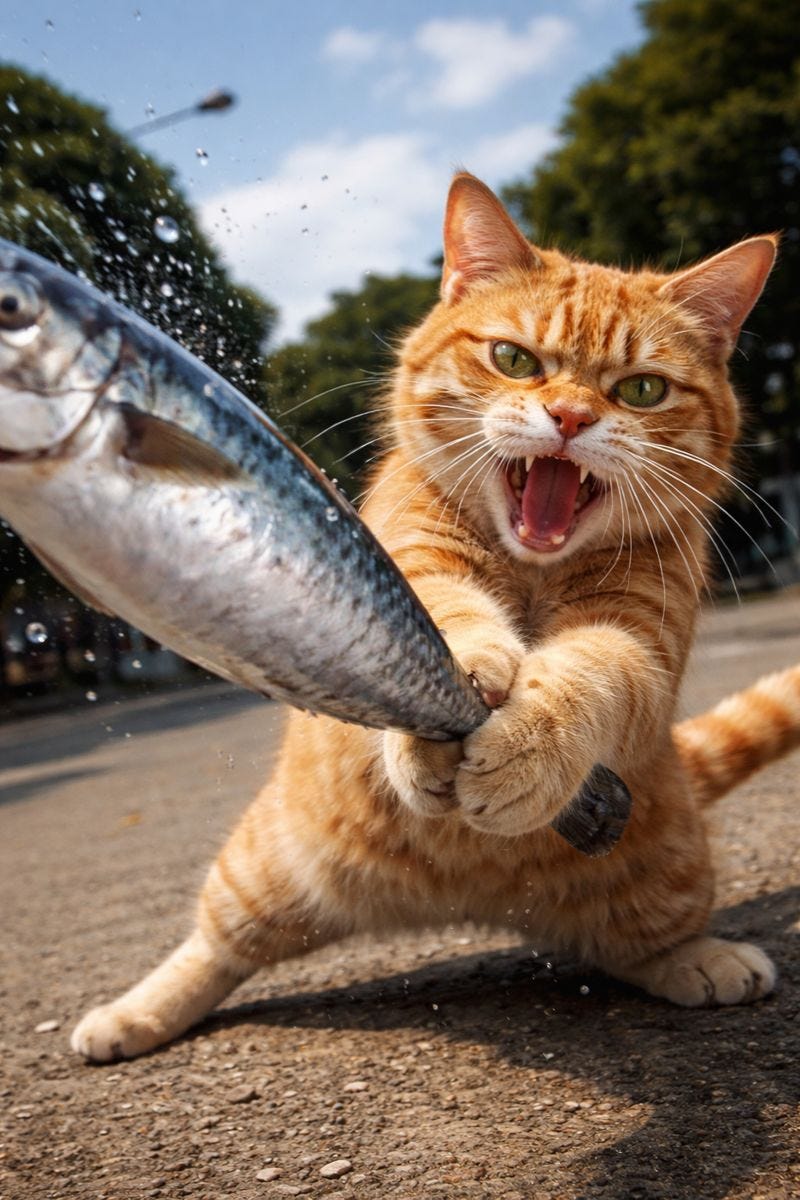
and if they get their way, the mackerel of truth arrives, wet and slappy.
in the end, all soft times must have hard men standing behind them to keep them safe. they may seem vestigial, brutish, and inconsistent with mores, but when they are gone, systems struggle to sustain themselves.
they become practice underpinned by unreality.
and pretty soon someone realizes it and it all goes sideways.
consider the idea of anarcho-capitalism and extreme voluntaryism.
it’s a wonderful precept, a perfect system for a golden age of choice and flourishing. but can it exist outside of a vacuum?
we’ll all get along and respect rights and act freely. we’ll secure what is ours personally in righteous self-defense if the need arises. a likeminded few protected from without might manage such a thing, but out in the big old world, this, like so much of today, is a soft power system underpinned by a hard power fallacy.
there is a reason you see no examples of this persist: that’s not how it works out.
you have your ancap homestead. i grab a gun and come and take it. so you go convince two neighbors to help you come and take it back. then i go find 10 friends and come and take it again. so you find 20. so i find 40. and pretty soon, we’re living in warlorddom and whichever warlord manages to field the most effective fighting force gets to hold territory and (if they choose) have ideas like “rights” for those within their domain. or perhaps they subject you to a brutal, rapey theocracy or a confiscatory collectivist comintern with a fetish for struggle session and gulag. but in the end, whichever warlord winds up stably and durably ascendant becomes “a government.”
this same issue iterates through shunning, sanctioning, or all manner of other peaceable penalty. being amish is all well and good until the mongols move in next door.
this is the hard power reality that “ideologically pure” people really dislike and edge-lord argue into seeming immorality, but this is an extreme and a dangerous luxury belief.
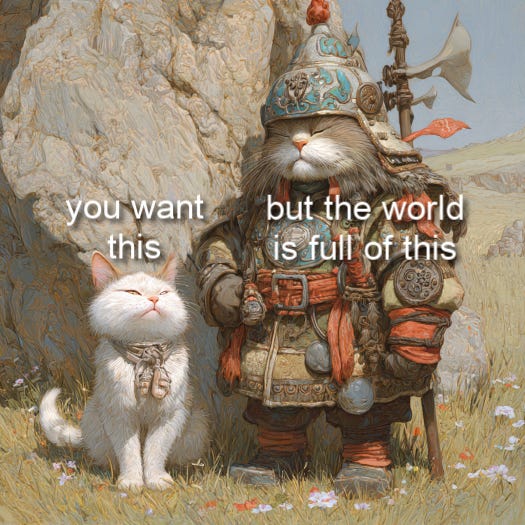
there exists a fundamental tension:
anyone who does not want to live under a pure libertarian/social contract system is favoring some form of oppression or subjugation. and it’s easy to take intellectual offense to this.
but anyone not willing to underpin their rights based system with hard power shall not long keep it. it’s a hard, unpleasant fact: all that you build will become an unprotected basket of french fries left for coney island seagulls.
there is no “perfect system” and so there must be compromise and a sort of goldilocks zone pursuit of “the best possible trade offs.”
and this drives us, of necessity, into debates like “borders” and “criminal rights” because, to take an example in widespread discussion of late: if you bring/allow in large numbers of immigrants who do not share your libertarian or rights based views but instead see them as addle-headed weakness to be preyed upon or (worse) as submission to them and their hard power, then of what use is a soft power system?
soft power assumes goodwill, respect, and a desire to live in a world of suasion rather than compulsion.
but what of he who not only fails to share that view but repudiates it?
are we, each and all, to defend ourselves alone or in voluntary groups of our peers against this? what about when the groups of newcomers become too large?
this is generally why you have “a government.” absent some protection of “the state” the sheer amount of time, treasure, and effort each individual must spend fortifying and defending their property and liberty becomes prohibitive. do you really want an armed guard in your house all the time while you are at work? high walls? unbreakable glass? slit windows and vault doors? it’s not a great way to live and running a high functioning economic system in a world like that is basically impossible.
by this mechanism, the very plenty that gives rise to the soft power ideas of highly permissive states and apologetic and indulgent justice systems is removed when those systems grow too soft.
“stop, or i’ll say stop again!” says the powerless policeman.
but no one stops.
“this is not in keeping with international law!” says the powerpoint general and position paper politico of the UN assembly.
“you and what army?” says the aggressor. (see, i told you we’d come back to that)
the hard part in this system is that everyone is right.
“respect my morality and become moral yourself” is ethically correct and intellectually sound. the world would be better if people listened.
but not everyone will and so those saying “make me” are also right. there is no “what one wants” only “what one can do” and “what one will do.” it’s reality 101 and bringing soft power to a hard power conflict is a recipe for an ass kicking.
and i think this is the lens through which to see the world right now. we are in a soft power to a hard power transition and this contains and demands a fundamental turnover in leadership at basically every level, international, national, organizational, social, and even familial.
soft power captured institutions and mistook the institutions themselves for the base of power, the gavel for force of law, the proclamation for the ability to enforce it.
the “soft power leaders” have been ascendant for a long time. and once, this was great. talking shops replaced armies crossing borders, rights replaced brutality, and acceptance replaced exclusion. but it went too far, too soft. it began to forget, ignore, even repudiate the hard power ideas that allow soft power regimes to stand. it begat dependency, complacency, and perhaps worst of all gave rise to and came to lionize a form of soft power bullying and bigotry that, itself, began to reach for levers of power that bring ruin.
“people should be free to be themselves” veered into “you must accept and laud my identity, hire me for my intrinsic traits, and kowtow to my vilification of yours. your places in schools and work and government must go to me.”
international health organizations started seeking dominion over sovereign states.
the UN made increasing pretense to authority on global social and climate policy, on energy and health.
the EU/EC demanded policies unpopular with those they claim to stand for.
justice systems became two and three tiered, granting license to some and brutalizing others.
policing was neutered. crime flourished
cultural attack was called enrichment.
economic engines were broken by ever greater regulatory encroachment.
families were assailed.
teachers picked genders.
the list goes on and in an age of aggrievement narrative and marginality worship, a great many of the most soft-headed of people came to wield large amounts of soft power and the hard fact is that, however intentioned, this destroys rights and flourishing and creates a system where soft power turns upon hard men who eventually run out of tolerance and rise.
“you and what army.”
and that’s where we are right now, the early days of the rise.
it’s why those now so accustomed to inhabiting the bully pulpits of the church of “do what i say, ‘cuz, words!” are losing their minds and why so many leaders around the world are so polarized about trump.
globally, the game went hard power again decades ago. china is playing that way, so is russia. so is africa, iran, and the middle east. the post ww2 “world order” got hollowed out into a potemkin system. NATO became “the US and its dependents.” the UN became a green grift wrapped in the kind of morality where nigeria or indonesia heads the human rights council. the IMF, world bank, WHO, and others became political, captured, and problematic.
and the masks of their suasion slipped, their soft power was revealed to be empty.
like him or hate him, trump is a master of this. he’s a hard power guy, a guy who uses leverage aggressively, forces hands, applies aggressive pressure near instantly and really does not care if it upsets you. consensus ios not even a concern. this is how he always did business. (and why he would not be the sort of person i’d want to do business with)
he’s an unpleasant bull to have crashing around in your china shop, but he also demands the question: so why was your shop so wide open to team taurus in the first place? have you no power to keep him out?

i swear this is half the trumpian divide:
the hard power people who have had it with being hectored and bullied and who see threats in the world emanating from other hard power players love him.
this gets especially acute at national levels among those who have faced large numbers of immigrants from hard power places who see “words” as weakness and soft power as utterly ignorable. those exposed to such feel a loss of the high trust societies they once inhabited and are anxious to meet hard with hard.
meanwhile, the soft power people who derived power and prestige from maintaining deference to increasingly toothless regimes of “consensus” and “memos” and other such academic and institutional shrillery hate him because he’s the one taking away their influence with the magic words that break their spell:
“you and what army?”
the leaders, the presidents, the prime ministers and secretaries general, they understand. they knew that they were playing a hand in which they held no cards. they hate trump because he called the bluff.
example:
for decades the US has said “you guys need to fortify greenland.”
anyone who can read a map and understands shipping routes, arctic minerals, or ICMB paths understands this. russia certainly does. a great power game is brewing to contest this.
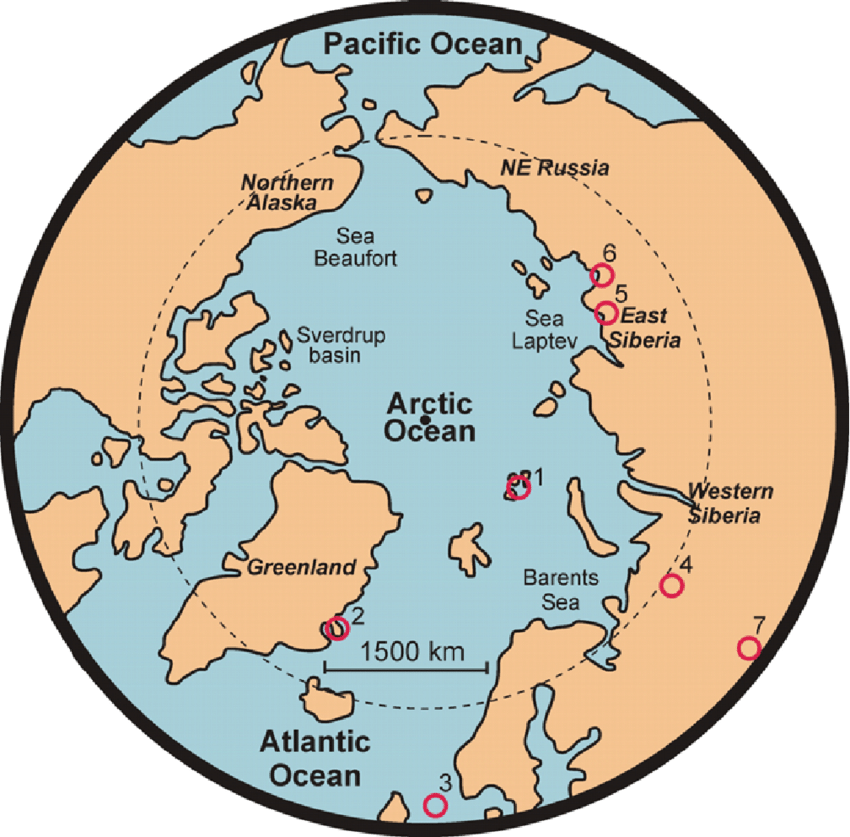
“no, we’re fine” says denmark and NATO. “there is no threat there. watch me wave my binder full of fine ethical precepts and international law!”
so it’s all safe?
ja!
well, i’m going to invade it!
what? you cannot do that!
i can. could you stop me? you and (you guessed it) what army?
<sputtering in danish drowned out by francophone garbling from brussels>
and suddenly, the US can put in bases.
is that a moral way to extract concessions from your erstwhile allies?
perhaps not.
is it hard power realpolitikic reality?
yessiree bob.
and the world is going back to this all over.
the pretense to soft power stability has collapsed in a pile, the tide has gone out, and those who have not been wearing bathing wear are suddenly showing a lot of flabby birthday suit.
some seek to style this immoral or amoral, but there seems a potent and honest rejoinder to such claims:
“we will not be bound by this system which fails to protect us nor sacrifice the durability of our own liberty, prosperity, and civilizational sanctity and safety upon the altar of your national and international regimes which seem to us unable to protect or assert themselves and which increasingly stand antithetical to the stated purpose of keeping the world free” is actually a highly defensible moral position.
has it been pursued to perfection?
no.
i’m not a fan of much of trump’s trade policy, but his message in davos was clear:
“we’re done surrendering to soft power and trade deals we don’t like. levaerage beats lectures.”
(predictably, the low leverage lecturer class dislikes this)
“sovereignty matters more than consensus, especially when your “consensus” is to censor your own people and suppress them politically as a trojan horse to try and export those policies here and to dominate US social media as well.”
he full-blown reset the room. they went from theoretical to real.
there was a round of bluster, but that was just the anger phase of acceptance.
USTR greer took more shots at the globalists:
globalism has failed structurally. you became silly and cosseted and regulated and weak. you don’t grow. you don’t innovate. what power do you have?
wright went after energy:
energy security and supply, not climate theater.
the group jeered lutnik for this, lagarde walked out.
but what else can she do?
europe was offended because everyone saw how naked they were.
this was not a nice or pleasant or friendly way to bring about change.
but it was clear:
the days of managed outcomes and consensus without accountability ended.
these folks will adapt to a new reality.
the harder climb is for the “useful idiocy” of the softtariat, who, having come to power through soft means, lack grasp of hard power reality.
they assume power stands behind them, accrues from consensus and institutions.
they belive in “magic words” and free lunches, in “but i cried, where is my cookie?” (see past piece (from the wilds of 2023) on magic world cults)
others are coming to the same conclusion.
this is the correct encapsulation:
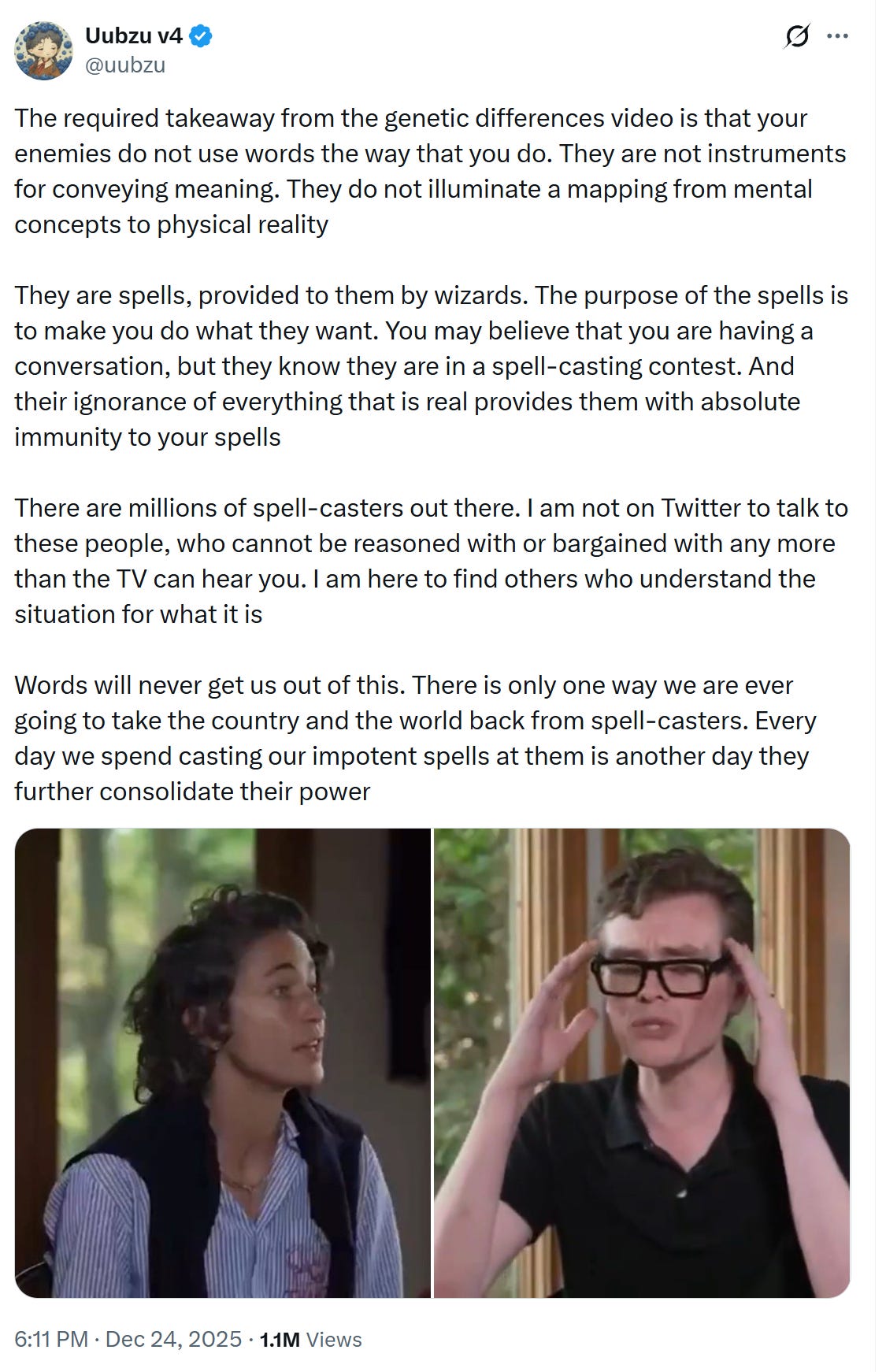
see the encapsulation of hard vs soft power?
soft power runs on belief and deference.
it requires cooperation and commitment to a system.
without this, it has nothing.
so as these diminish, it’s why you get the frantic, emotive mess that seems so endemic at the moment. you see such rage because “what is left when soft power entitlement is knocked from its perch and the soft men of soft times hit hard realities?” there is just sound and fury signifying nothing, a colicky baby convention of the formerly influential raging at the dying of the light of their power.
the rage will be most profound among the least of the powerful. those with true power understand, at least to some degree, what power means. but the low level bureaucrat? the PTA karen or the diversity dean? they have been snug as bugs in rugs inhabiting word wizard LARPs where they possessed eldritch powers that commanded respect.
being shown to be a bunch of toddlers running around a theme park waving wands that mommy bought them for $200 and yelling “structural ism!” as though that renders foes inert and wins the day breaks the foundational ideas of the external identities that have stood as axis mundi in their worlds.
of course they’re losing their minds.
their whole world just evaporated.
not only have they lost position and power, but their internal image. their ideologies are in dissolution and their sense of self so long rooted in “being an authority” is gone. and hell hath no fury like the sputtering impotence of the former popinjay. but it’s all just fluffing and feathers. there is not much underneath and the game of “i will scream in your face because i am untouchable” stops being fun the moment everyone else stops respecting the rules of “punch, no punchbacks.”
those long ensconced in power perceive their loss of prerogative, unaccountable to others or even to reality as tyranny. but this is inversion and projection, a mistaking of the end of the longstanding privilege of word wizards for tyranny, for the loss of an unearned crown to slavery.
and in the end, their “feels” will not amount to a bucket of warm spit.
this is sweeping change into every institution.
globalism is getting kicked from pole to pole.
the US internals are swinging back to enforcing rules and norms long lost.
“but my rights” and “but your laws” fail as a defense by rights and law disrespecters.
media fails as “no one wants to watch or read this crap.”
businesses unwokify themselves because they discover that they are no longer good at business and start getting whupped by those who are.
whole multi-layer systems of preening preference and hectoring subjugation fail in the face of 4 simple words:
“you and what army?”
the hard men were never gone.
and they are not tyrants.
they are guarantors.
they are the ones who stop the pendulum when it threatens to swipe out the foundations of civilization and order.
they are the ones who sweep away the corrupt and ineffective malignancies that metastasized in organizations that flourish in systems where words are mistaken for power and maps for terrain.
and they are the ones who will once more stand behind the soft power that brings comfort and plenty.
this is the burn ecology of civilization and like any forest, it’s better to burn early and often and before too much underbrush grows out and too many trees turn to dry tinder.
our founders understood this keenly.
they were students of it.
and trees of liberty are not watered with abstrusities and position papers.
and so the torch passes to us and our times.
Governments are instituted among Men, deriving their just powers from the consent of the governed, --That whenever any Form of Government becomes destructive of these ends, it is the Right of the People to alter or to abolish it, and to institute new Government, laying its foundation on such principles and organizing its powers in such form, as to them shall seem most likely to effect their Safety and Happiness.
for these precepts apply as fractal, self-similar at every scale.
and they are back.
us.
and this army.
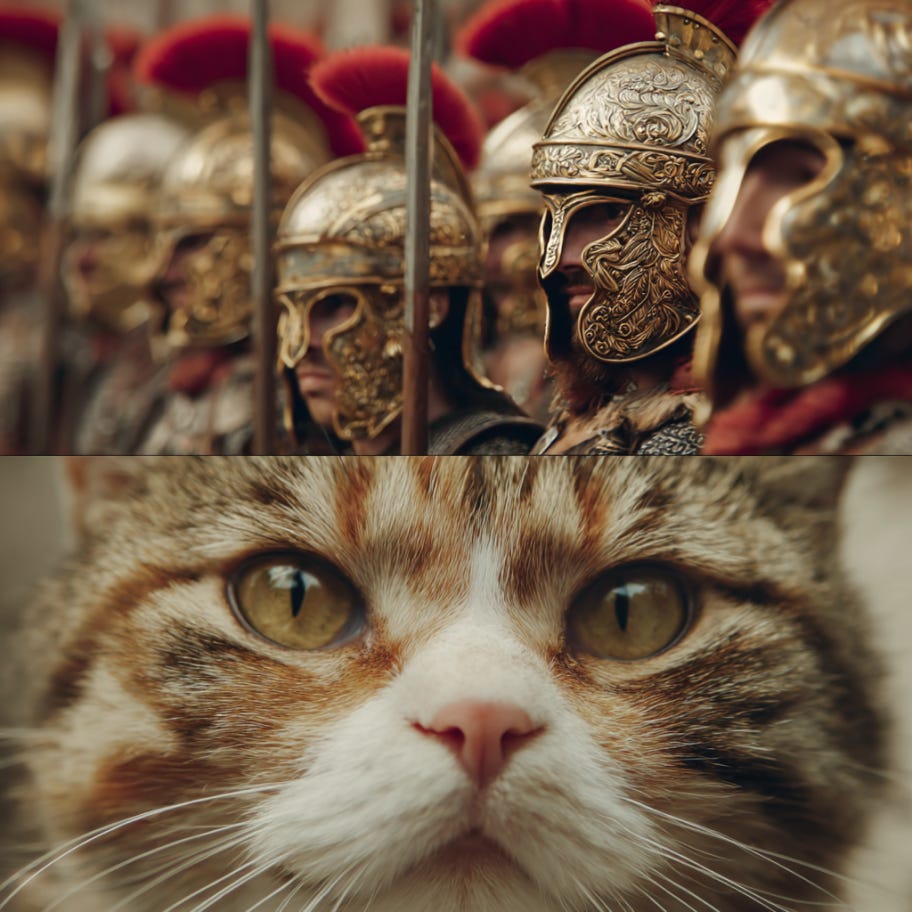
George Orwell put it this way: "Pacifists sleep well in their beds at night because rough men stand ready to do violence on their behalf."
God bless the rough men.
A strong man without restraint is a tyrant. A restrained man without strength is a slave. But a strong man with restraint is free. Man is a microcosm of his government.