
peak hostage puppy
harvard pleads poor

we’re getting very close to peak hostage puppy.
you can tell by how hysterical and badly framed the ejaculations of outrage have become and the hilariously wobbly foundations upon which they are being erected. the whole of this enterprise seems to have become one massive sleight of hand rooted in passing off bad logic and worse equivalences. let’s look:
if one is seeking misbegotten regime hysteria, richard hanania is always a good place to start, and this one is a doozie even by his august standards:
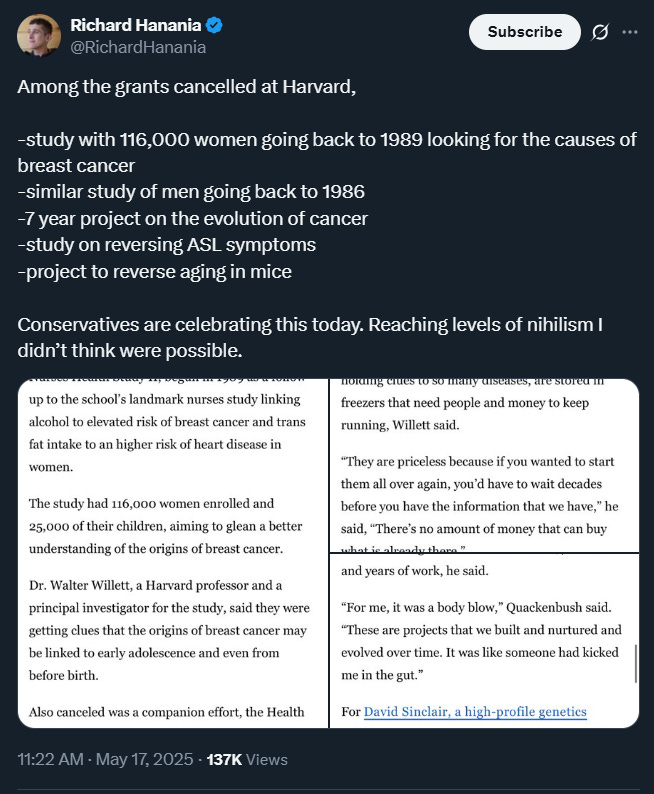
ooh, “levels of nihilism i didn’t think were possible!”
catchy, but it’s pure projection.
here we see the classic hostage puppy framing. “if you cancel the 3,000 awful and stupid things we are doing you must also cancel these 3 things that we will point to and say ‘well what about this wonderful thing? are you trying to kill the puppy?’” as if this is the whole of the matter.
it’s grandstanding to select a few points to stand for a whole.
the implication is obvious: you want women to die of breast cancer! this work will all be lost! it’s too important!
it’s just the national lampoon cover, over and over:

it’s also still an entirely vapid and dishonest presentation of facts and choices.
let’s take dr willett at face value and assume that indeed, this is important, critical work that could be lost. he’s quite literally saying that the freezers might need to be shut off and all the tissue samples from this decades long term cancer study would wind up destroyed.
sounds dreadful, no?

probably not so much, no.
now, i’m no appliance economist, but i have a sneaking suspicion that a $53 billion tax-free endowment is enough money to fund “electricity to keep some freezers plugged in” if this work is really so important and irreplaceable.
in fact, i might even go so far as to venture that if the university (or some other backer) could not come up with a $100/freezer/year to “save this research” then perhaps some pointy questions about just how important they actually think this data to be ought be raised.
a $53bn endowment throws off $4.9bn per year, literally $563k per hour in returns (using 9.3% return, harvard’s 7 year historical rate). that’s ~$1,600 per second. surely if this work is as critical as claimed, harvard could spare a handful of seconds from its annual return to pay the electrical bill for these freezers full of precious cargo. the fact that this proposition of “having to shut off the fridge” is even on the table at all is pretty ridiculous.
this is an unserious claim made by unserious people.
dr willet tells us “these are priceless” in his breathless quotes, but it seems to me like if they will not pay a couple grand in freezer bills to preserve the study samples, then they are quite literally putting a price on it and that price is very, very low.
if they will not make such a meager investment to preserve such groundbreaking work, then surely one must question either how important it really is or harvard’s priorities.
i am not sure whether this is complete, but based on a best efforts deepsearch to find the grants given to dr willett and his projects over the last 10 years, this is what i found:
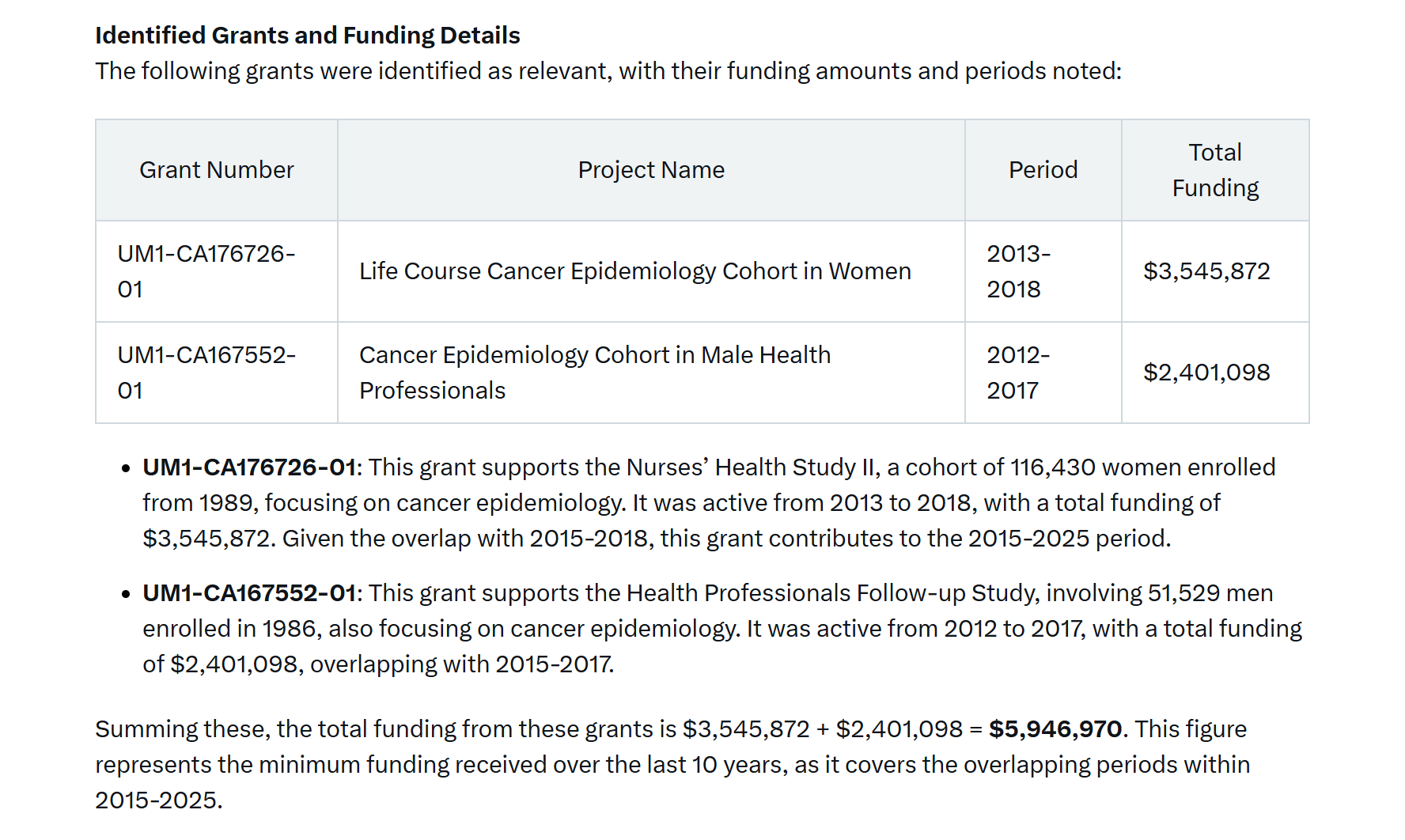
$6 million over 10 years. that’s a nice chunk of change, but $600k a year is a pittance for harvard. it’s barely over 1 hour of the annual returns to their endowment which, as mentioned above, would currently be expected to generate $4.9bn a year in profits without even touching the principal. dr walter’s whole program would consume 0.000122 of this per year to fully fund. hardly “break the bank” levels of investment to preserve the priceless.
the good doctor himself likely earns $350-500k a year at harvard (i could not find an exact number but he’s a 250-300 base with endowed chair supplement and likely grant funded salary) but surely this would be sufficient to, at the very least, spring for a few grand in freezer fees to keep the work of his life intact.
this whole line of histrionics is a nonsense. all of this is easy to fix, they just do not want to fix it because they’ve become accustomed to getting the goodies for free.
in 2024, harvard got $686 million of federal funding. this is a meaningful portion of their $6.6 billion operating budget. but that really does not take the full facts on the ground into account.
harvard spits out huge piles of profit from its endowment. it earns 9.3% a year but only pays out about 5%. the rest is retained and compounds. the endowment made $4.5bn in 2024 but only paid $2.4bn into the operating budget while slurping up $686 million in taxpayer funded grants.
had harvard instead paid out $3.1bn, they could have still increased their endowment size by $1.4bn while covering ALL the grants and taking nothing from taxpayers and still had $14 million left to pay warren buffet to come to campus and teach the administrators some basic accounting.
so this is easily in reach for them.
it does not even stress them.
if they wanted to fund dr willett and every other researcher like him, it would be a simple matter to do so even if assets were illiquid as borrowing against them is trivial and they could easily adapt to larger draws going forward over a few years of investment repositioning.
if they paid out all $4.5bn of 2024 gains into their operating fund, they could have covered all the grants AND make all tuition and housing at harvard free and STILL be running a surplus.
worth keeping in mind when folks start flexing about having to shut down freezers for lack of funding…

schools like harvard get panoplies of tax breaks and subsidies. but why are we subsidizing something so incredibly rich and, more absurdly, why are we allowing one of the wealthiest educational institutions in the history of history to so baselessly cry poor?
$53bn is quite a large tax-free hedge fund to run. if its purpose is not to fund research like this that is deemed so irreplaceable and important, then what is it for?
seriously? why create all this advantage if the end result is just capital accumulation?
isn’t this suppose to be used for something?
just what are the a priori priorities here?
when you boil this whole episode of financial theater down, the smell gets pretty bad:
“so vital that the public needs to fund it but not vital enough to spend some small pittance from our own croseus sized cashpile’s vast returns upon” is really not much of an endorsement, is it?
nope.
these people are lying.

and of course, going begging in all of this lies the greater question of “so why are these grants being shut off at all?” for beneath this question lies yet another layer of hostage puppy practice.
this whole issue is over DEI and harvard’s demands to discriminate based on race, gender, gender construct, and whatever other fashionable ideological and sociological purity tests they wish to impose these days “because structural ism and diversity deans.”
it’s a choice.
it’s a trade off.
i think they should be free to make it. have at it, go nuts. you’re a private institution, make private choices. i will vehemently support and defend your right to do so. free association is a bedrock right that need never explain itself. “because i want to” is sufficient.
but, and there’s a big old but in there, if you wish such agency, you must stop taking mine. you must stop taking tax dollars (by force) from we the people and using them to fund your choices. you cannot have it both ways, to be a child that gets an allowance and lives in mom and dad’s basement but be treated like an adult that gets to make adult choices. allowance and dependency come with rules. harvard leadership made a decision to break them. actions have consequences.
embedded in this is the inescapable takeaway that it is not, in fact, the government that chose to say that this cancer work was not important, it was harvard.
harvard was faced with a choice: stop engaging in overt, purpose driven DEI, or lose your grant money.
they chose DEI over cancer grants.

they face another choice:
fund this purportedly critical and prestigious research from their own enormous endowment and the billions it generates each year and they may stand alone and do as they please.
it’s easily affordable.
the choice is simple and within reach.
nothing save a bit of capital accumulation need be forgone.
their choices here will speak loudly:
if they will not fund it, why should we?
“good enough to spend your money on but not our own” is hardly a ringing endorsement of “too vital to stop.”
once you peel it apart, this whole argument inverts.
if (and i doubt they will) they allow this to fail, it’s not even a hostage puppy, it’s a sacrificial lamb being chosen to die in order to score political points.
there is no need to let it fail and it is absolutely a choice if they do, a decision made from priorities, not exigencies: there is no hard-choice “either or” trade off here.
choices demonstrate the underlying values of those who make them and the only values i really see here are “gimmie dat.”
note that no one is calling for solutions, just making threats of dire outcomes if the spigots of free cash is not turned back on.
richard never thinks to ask harvard to fund this.
he never thinks to ask some private actor to do so.
it’s like watching the global warming green-grifters vilify nuclear power because they do not want to resolve the crisis, they want money, specifically “someone else’s money.” there is no interest in “fixing the problem” or “standing alone” just in keeping the flow of federal funding fulsome and “free.”
this is subsidy suck and sinecure masquerading as dire and dangerous need and the masks are slipping.
if this research is worth saving, harvard could save it with minimal effort.
if they choose not to, what can one conclude?
either it was not as important as they made out, or (likely) worse, it was important and they chose to destroy it to score political points.
which one of those is a set of priorities that makes you want to fund them?

Harvard can quickly cut $450,000 a year. Stop paying Elizabeth Warren that much to teach one class each year. That would be sufficient to keep the refrigerators plugged in.
Well, in all fairness, he might be a hero who donated the freezers he had to keep the MRNA vax at their mandatory (-)70 degree temperature in order to make sure they would remain safe and effective.