

there is often, perhaps always, an inherent tension and debate between the high ideals of intellectualism and the drives for “intellectual purity” they tend to encompass and the messy practice of applying ideas and ideals to human society. no rule book or ethos, no matter how well conceived can escape this. there will always be edge cases and limits to institutional and functional capacities.
example: rights based trial by jury works to a point. but it assumes that judges and prosecutors and juries are reasonably honest and honorable and capable and that they seek to serve even-handed and blind justice instead of some other end. and a “jury of your peers” presumes that a group of selected citizens are likely to share a value system. it sets a high bar for due process and due deference that is institutionally expensive to sustain and to operate and this limits system capacity. if you swamp a system that can handle 10 cases a day with 100, it cannot function especially if it contains a core idea like a right to “swift and timely justice.”
it also assumes the ability to punish and deter, but this too is expensive and limited. you can swamp prison capacity and remove this ability. each new detainee requires the early release of some past one.
the high ideals of “every man deserves his day in court” and “rights respecting” and “innocence until proven guilty” and “trial by jury” simply cannot function past a certain scale. as soon as every man is demanding it, they cannot have it and even in the event that the system manages to remain honest and uncaptured, it locks up in backlog and revolving door malfunction. many parts of the world simply never had this or, like singapore, abandoned it as “simply not effective/suited to here.” it seemed to work reasonably well in the west for a time, a fine meshing of ideals and praxis, but i suspect that far fewer would make this claim today than in decades past.
this sets up an interesting and fundamental debate and on in which i fear that two groups who really ought to be allies are finding themselves in opposition, perhaps because they have misframed the issue and are talking past one another.
one side of the debate goes like this:

and it has truth to it. as pure ideals, you basically cannot contend with or refute the libertarian ideologies. they are the king of the salon, the academy, and the logic tree. but that does not make one king of the world because in the messy precincts of humanity, the terrain is never the map and the perfect conception of order so clear to the philosophe becomes an unattainable perfection that all too often stands as the enemy of the good and, once things start to go wrong, as a bastion against the better. and this is where, to my mind, many libertarians are really blowing it right now and have lost their way.
and it’s what’s leading to meghan’s comment here having some real bite.
despite overstatement and overextension, in a core aspect she is correct: the edge-lord academic absolutism of libertarian ideals has, given many of the difficulties of the moment, made their adherents into impossible coalition partners who, in pursuit of rights in principle are advocating for rights in praxis which tend to make the very idea of a rights based republic impossible.
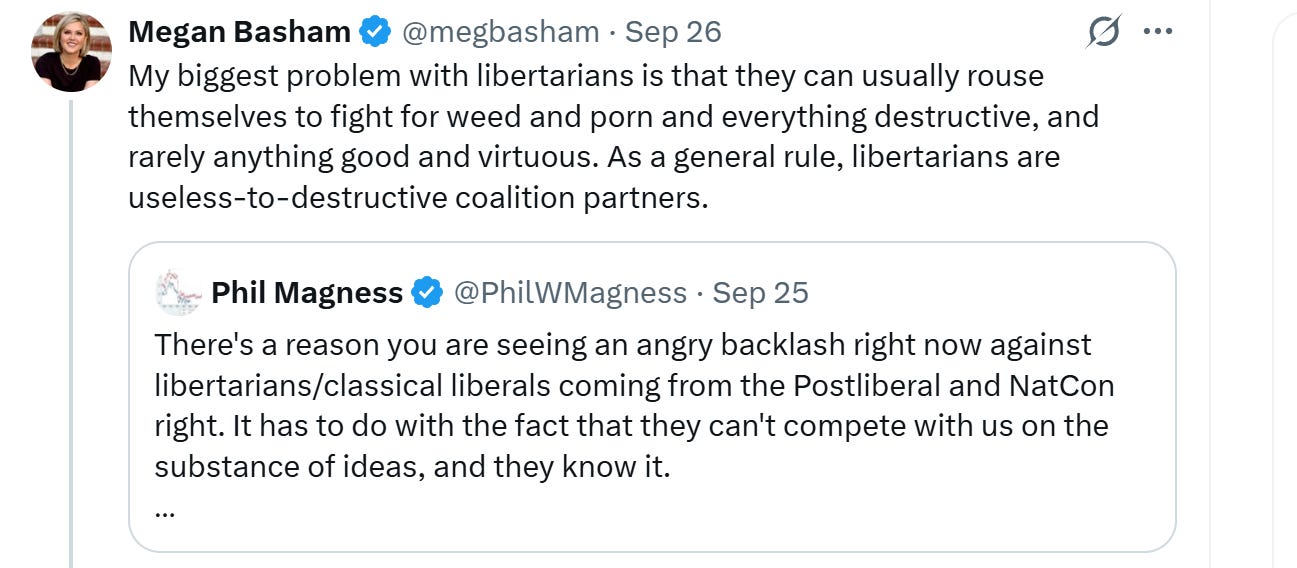
phil’s response to this frames the sides “talking past one another” perfectly.
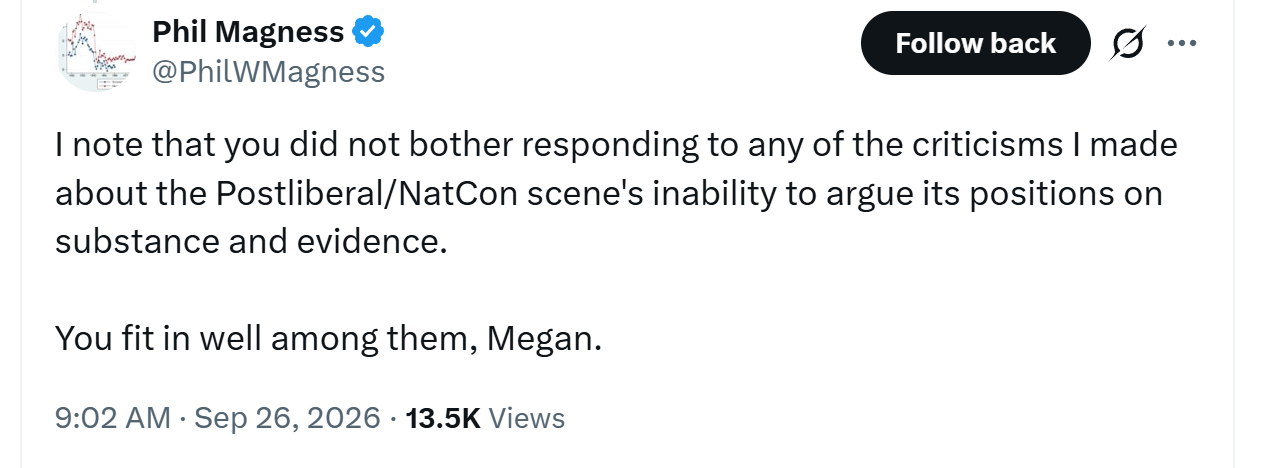
he is correct in that megan has not addressed his intellectual points (though they were mostly, in substance, alluded to and not actually made) but he, in turn, has failed to respond to her point as well resorting begging the topic in a manner that, ironically, helps bolster megan’s point about libertarians tending to be destructive as coalition partners. it also makes my point about the whole “intellectualism as process being impossible as praxis” in the sense of “you must refute every point i allude to in order to respond to me. you are not allowed to make one narrow point,” a point, i might add, that phil does not seem to grasp. it’s the issue that swamps a court or prison system: a failure to see limits to capacity (or desire for it).
this frames the issue:
i think that both megan and phil have some veracity to their claims. phil is correct about intellectual heft and its conspicuous lack among the natcons. the problem is that this libertarian/hobbesian/lockian/rousseaian idea around social contract and rights based republics, however mighty it may be in the salon, is being eaten by a massive libertarian blind spot about human capital and it’s rendering the valuable ideals of the philosophy not only inaccessible but perhaps self-destroying. and this makes megan’s point about collation partners.
just how useful is a guy with perfect intellectual knowledge of ship design who keeps drilling holes in the bottom of the boat?
this is, of interest, an idea that was in widespread currency among our framers. they were not “big tent inclusionists” they were societal curators and understood well the limits and boundary conditions of the form of government they sought to erect.
it’s noteworthy that adams penned this to a citizen militia amidst active military preparation to protect american rights and shipping from outside incursion.
he places his trust in the quality of the citizen soldiers gathered at lexington as bulwark against the demands of the french.
only in a certain sort of person may such trust be placed.
and that, indeed, was the point.

to paraphrase sowell, civilizations (and philosophies) decline by forgetting the obvious things.
i think there is an obvious thing here:
the challenge of libertarianism and the idea of social contract is that it only works if those you seek to encompass and thereby by their own consent govern are, themselves, libertarians.
this is a boundary condition. out in messy reality, outside of academia and its utopian assumptions it must pertain. it’s the line that separates philosophy from practical praxis.
it presupposes ideas like “ability to pass a marshmallow test” and “ability to see why golden rule non-defection in iterative prisoner’s dilemma” leads to better outcomes because we all brought the shopping cart back.
it assumes that people will see the reciprocal nature of a social contract where agreeing to be bound to respect the rights of others gains one the protection of others agreeing in turn to respect your rights.
the libertarian parlor/academy tends to boil down to ideas like “weed” or “porn” or whatever because among the sort of people suited to libertarian governance, all the big topics are basically covered by social contract and natural proclivity and tend to get seen as settled. for high trust human capital, there’s just not much left so the debate winds up being over relative trifles.
the bad assumption backed into the inclusive libertarian ethos is that “everyone can and will do this if we just show them how.” this is not correct. it’s the opposite of correct. and therein lies the disconnect.
the problem is that lots of people are not suited either intellectually, emotionally, culturally, or along some other dimension to this sort of golden rule rights respecting. they have high time preference and disdain the idea of honest dealing and word keeping or system respecting because they fail (or are flatly unable) to constrain themselves with notions like “if everyone sought to take as you are about to, there will soon be no system left worth taking from.”
they think you are a chump and an easy mark for thinking such things.
and they see accommodation and appeasement as either a feeder bar to smack for more goodies or as weakness and a sign that they should push harder because you fear them and you’ll engage in more surrender.
both incentivize breach of contract.
and a social contract cannot co-exist with this.
and this is always a function of scale. “hey, let’s let this one outsider in and see if they fit in” is a matter that the institutions and social substrates of a high trust system can manage. but past certain quantities this can no longer be managed or assessed and incentives flip. those flooding in no longer fear rejection for abusing the system. the whole highway is speeding and there are not enough cops to even make a dent by pulling people over.
and golden rule systems cannot survive that.
high-trust structures run on confidence in the trustworthiness of others. it does not take much defection to break that and cause the system to collapse.
libertarian living is, by far, the best path to plenty and human flourishing and agency if you can manage it. but the seeming blind spot among many self-described libertarians is that if you extend the protections of the social contract to groups of people who have no intention of being bound by it and instead seek to take advantage of and even weaponize it, you get disaster. those people who cannot or will not abide by the idea of a rights based republic and engage in mass defection in the societal dilemma shove you down to a low equilibrium from which you cannot escape.
once you violate the boundary condition of “this system only works to govern certain sorts of people” the system cannot work. for this reason, “big tent all are welcome libertarianism” is not and cannot be a thing. there is and must be a “must be this tall to ride” moral and cognitive screen. it’s the fundamental contradiction in the ethos:
to have a libertarian society, the entrance screen for the people invited to live therein must be decidedly non-libertarian. it requires curation for social contract followers and such curation is inherently scale limited both in terms of which people in the world can or would participate productively and peacefully and in terms of the society’s own ability to assess and correct/expel those within it who fail its standards.
this has significant implications.
a strict, rights based system is the worst possible form of government if it includes large groups of non-rights respecters. the very ethics that lift such a society of high trust people up become the boat anchor that drowns it because the “rights are for abusing” faction will howl “but my protections!” as excuse for predation. the best, hung on their own empathy and rights respecting, are set at the mercy of the worst and the alinskyite tactic of “hold the enemy to their own rulebook” renders the systems and institutions of the republic entirely insufficient to staunch the bleeding or repair themselves. they just get more and more captured and corrupt. they lack intellectual and functional capacity to handle the problems. absent vigalante violence, the social contract cannot be kept.
there are no good answers once such a state pervades, it’s the horns of an unresolvable dilemma.
the only winning move is to find a way not to play.
this is why i think that to truly pursue the libertarian ideal, one must become a strict social contractor and essentially say “well, the minute you stop agreeing to be bound by our compact, it will cease to protect you.” you are free to do as you like, but not to do it without consequence. such justice must be swift, sure, and possibly final, not the tepid catch and release deferred, delayed, and excuse making system of unequal treatment and unlikely punishment currently prevailing. and it must be implementable right quick and at scale.
western systems as instanciated are for a certain sort of person both as jurist and defendant.
they are wholly inadequate to any other.

and when a judiciary or a jury themselves cease to be social contract upholders, they become social contract destroyers.
the social contract requires the maintenance of agency. “i got so high i strangled a girl” is not compliant any more than “i was so drunk i drove through a playground” would or ought to be.
denying that simple requirement results in the perversity of: “his inability to comply with the elementary rule of the social contract is used to afford him the contract’s strongest procedural protection.”
this is the literally definition of the “protected but unbound” state.
at scale, it’s civilizational strychnine.
and the manner in which it manifests spirals through systems.
where can justice be found when it must derive from the hands of a unanimous jury who will increasingly always contain “peers” outside the social contract who openly disdain its precepts?
the math here is far nastier than people realize. for any given jury of 12, what % of the population must be “non social contract respectors” to have at least one on 50% of juries? the answer is 5.6%. to reach 90% likelihood? 17.5%.
see how little it takes to render “a jury of peers” deeply problematic guardian of a social contract in the face of determined defectors? (or a tribal weapon for in group out group preferencing that stands antithetical to “equal before the law”)
a jury must be unanimous.
all it takes is one to hang it. even at 3% prevalence, you’re going to wind up with such a person on basically 1 jury in 3.
and if that person consistently picks tribe over impartiality, how quickly will faith in courts fail among the rest of the population?
what hope has a libertarian system in such a state?
this is what makes immigration such a flash point. it is not the idea of immigration that’s problematic, it is the character of the immigrant and the practice of assimilation. are they rights respectors and social contractors or are they plunderers and wreckers?
some among the self-described libertarian purist wing argue “well they have a right to show us so we must let them in and see!” but, as discussed above, this logic fails on the basic level of being impossible at scale and dangerous statistically. “let’s dump a bunch of tiger sharks into the swim meet, we can always kick out the ones that bite!” is not much of an idea and the issue with high trust systems is that it does not take that many defectors to break them and drive the whole to the low equilibrium of expected defection. and once you are there, the system cannot repair itself.
scale is the limit of intellectualism and civilization. can the institutions of your social contract function to manage breachers? for any given set of institutions, this will always and inevitably be a function of “how many people in the society?” and “what percentage of these people are contract defectors?”
and the more rights your system affords and the more rigorously is applies them, the fewer defectors it can handle. the cost per defector adjudication soars.
i think there is basically a hard boundary condition here.
for those of a mathematical bent, you basically get an equation:
define:
N = number of people governed by the institutional system
d = effective rate of contract-breaking/defection
λ= frequency of interactions capable of producing an enforceable dispute
c(r) = institutional cost per alleged defection
r = procedural intensity: hearings, evidentiary burden, appeals, delay, review, etc.
K = total institutional processing capacity

the issue with a system like this is that basic queuing theory gives us a sudden tipping point and people do not see it because queuing theory is often counter-intuitive:
if you have a stable 3 minute bank line with one queue waiting for 4 tellers, how much does the wait rise if you shut down one of the tellers or if you make each transaction take 2 minutes longer?
the answer, assuming everything else stays equal, is infinitely.
line length is a function of “people exiting the front” vs “people coming in the back” and so if you take a formerly stable system and you keep “people coming in the back” constant while reducing people getting out the front, you keep building the line forever until people stop coming so quickly.
in terms of our equation:
ρ <1: institutions can clear cases faster than they arrive.
ρ ≈ 1: little spare capacity; delays become very sensitive to disturbances.
ρ >1: backlog grows without bound unless something changes.
if you get way more people entering the system the system must either:
get utterly swamped
start rejecting entrants (refuse to charge, try, or hold)
massively expand capacity
or reduce the standards for trial and speed the throughput
and note that “capacity expansion” presumes availability of capable juries and judges and prosecutors and of ability to impose sanctions (like prison) credibly.
it also implies that those seeking to render it dysfunctional will not simply move to an adjacent space like “every defendant needs to undergo rigorous psych eval.” how quickly could that exhaust capacity and generate long lines?
and if the system gets swamped and sanctions are infrequent and ineffective, then the expected value of defection rises and more people choose to defect which rapidly makes a society and a system non-functional.
you see this in the sorts of justice systems (and particularly police powers for search and arrest and interrogation) that emerge in low trust places.
no one steals if 100% of thieves are immediately and roughly arrested, tried, and their hands are cut off. but when courts are flooded with too many cases and punishment is reduced to scolding, you get the opposite.
not all people are good or follow golden rules. such people may be contained/deterred by high functioning, credible institutions, but when those institutions lose credible function, containment is broken and contracts violated.
and that means nothing works.
in the presence of bad people, you cannot have a libertarian system without credible sanction for defection and you cannot have credible sanction for defection at scale without either abrogating rights and process in trial and punishment or by making sure you keep the number of offenders and offenses down.
the former repudiates the idea of rights based contract, so if you want to keep it, the latter is really the only practical option.
this inherent and inescapable limitation mandates a simple conclusion and unpicks the libertarian contradiction:
the more rights and veto power against institutional system sanctions that a system affords to its participants, the more latitude is inherent in the social contract; but this latitude can only be sustained by people of libertarian bent who place values of even-handedness and impartiality above tribe and short term plunder.
reality is not optional.
you really just cannot get away from this:
social contract requires social curation and social curation requires social borders and social discernment.
the constitutional protections that allow inherently high trust people to flourish turn toxic and adversarial to liberty and contract in the presence of even fairly small numbers of low trust humans.
it’s quite literally just math. (and non-linear math at that)
high trust freedom works for a certain sort of person and no other.
its systems cannot survive the adversarial admixture of the people who not only take farmstand eggs and fail to leave $5 but grab the money out of the jam jar while they’re at it.
in the end, there exists a fundamental trade off that cannot be ignored or avoided (and one with which any parent will be readily familliar):
the freer the system, the more demanding its human-capital assumptions must become.
to couch this in economics terms (as would the politico-economists of yore who failed to draw distinction between the two disciplines):
liberty is an equilibrium good not a constitutional incantation conjured into being by words penned upon parchment.
the less restraint a system imposes from without the more restraint its participants must supply from within.
as defection rises, attempting to maintain the same rights and liberties requires ever greater institutional capacity and this becomes implausible and then impossible in non-linear fashion as the rate of defection increases because it at once causes more inflow into a justice system while also causing less and less successful outflow by tainting jury and judge pools.
once capacity is exceeded, either rights themselves or reliable rights enforcement and thereby trust must fail.
there is no other way. there is no “perfect the humans with my piece of paper.” ask liberia how having a close replica of US constitutional forms worked out for them.
laws can specify the rules of a high-trust equilibrium but they can neither generate nor at scale mandate the human behavior required to sustain that equilibrium. the trade off is inherent and unavoidable: the more liberty the rules provide by withholding external restraint the more internal restraint they require from the people who consent to be governed by them.
and not everyone is interested in or capable of that.
the original libertarian thinkers understood this full well. our founders and framers understood this. the current crop has forgotten because it all worked so well for so long that this boundary state was not tested.
they have forgotten what made it work and i fear that until they remember, the criticism of “these are bad/untenable coalition partners” will be correct.
many of the academic edge-lord libertarians have become mired in a self-defeating disaster loop as they keep demanding that the cohabitation within and the protections of the social contract be extended to those who cannot or will not honor it.
nobody seeking to restore and retain a high trust golden rule society wants to team up with the guys who keep seeking to back up the shark truck to the pool.

thus, my advice to the libertarians is “cease making the intellectually perfect the enemy of the achievably good.” intellectualism that cannot be made real is of little use and can be of real harm.
my advice to the conservatives is to realize that it is precisely the libertarian ideas of social contract and rights based republic that led america and much of the west to such unprecedented heights of human flourishing and that rejection of these ideas because some folks are applying parts of them wrongly is both unsound and unwise.
both sides want the same thing here.
to get it, the side demanding philosophical purity must accept the reality of its implementation, and the side demanding reality must get real about just how powerful and effective the philosophy they often critique was when it was properly instantiated and curated.
i think there exists a profound opportunity to agree to agree on most of these topics if we can get past the academic practice of seeking ideological/logical edge lord purity and into the realm of that which may actually be built and operated.
let’s not lose that amidst the bickering.

I used to hate this Freud quote, but I realize now that it is true for a large number of people: “Most people do not really want freedom, because freedom involves responsibility, and most people are frightened of responsibility."
After seeing the Covid-19 story play out, Solomon Asch could have predicted the results in the 1950s where over 70% of the participants followed the crowd with the wrong answer, even though more than a 1/3 knew it was the wrong answer. Less than 25% of the participants were unafraid to stick with the right answer and not follow the mob. Yikes!
According to John Adams’s writings, about 1/3 of Americans were patriots for the Cause, about 1/3 Americans were fence sitters and the 1/3 were loyalists to King George, so we won the revolutionary war with approximately 1/3 of the people backing the cause – and the demographics were mostly from cultures based on western civilization.
But, what do the kids see now? They don’t see a healthy free-market society; they see capitalism as it is now – crony corporatism/oligarchy, so it’s understandable to see why they don’t believe in it. And, being ignorant of history with the blatant failures of socialism/communism, they plunge forward as inadvertent useful idiots. So, how can we show them it’s all BS?
It’s all so depressing to think people would vote for socialists. And then, a “democratic” socialist walks into a bar: https://lizlasorte.substack.com/p/a-democratic-socialist-walks-into?r=76q58
Well, you're 100% correct here.
And even the Founders who'd founded such an extraordinary framework for true human liberty and flourishing within a nation-state--as soon as they went back into the real world they started screaming and yelling about too much free press and how their rivals for political office--who'd just been their colleagues in crafting that extraordinary framework--were just the worst human beings ever.
The only way to deal with this is to not give an inch on the standards and enforcement of them--but we see how well that hope does out in the real world.
Get on the school boards, kids. Get civics back in school. Get ESL out of school. Our only hope lies with ground-up restoration of what being a real American really means.