


the rationalist road to religion
southpark as the road to damascus?

i am aware that many who read this publication have strong and sincere religious beliefs. this is not a predilection i have ever shared and one for which i once had no small amount of distrust perhaps because my mind is of too objectivist a bent to lend itself to such ideas as justification by faith. but this onetime distrust of mine has attenuated and even inverted in recent years as i have come to a different sort of realization that while i may not share belief in provenance of the parables and foundational stories, that i can still see their use, their beauty, and perhaps most of all their ingrained humanity. i find myself friend to priests and rabbis and other such seekers in a manner i had not expected and have much enjoyed my many deep discussions with them despite our not sharing a faith.
in so doing, these disquisitions on the ineffable have felt to me as though they start to lead (in no small irony) to something that possesses a sense of being altogether evolved. they feel like human needs seeking human ends and human understanding and i have come to appreciate them and their possibilities in ways i once could not and i have come to love the views of folks like jung and joseph campbell on these matters as expressions (or perhaps mirrors) of the human subconscious and the quest of the hero for even if they are not entirely true or provable, they possess an internal (and perhaps eternal) elegance. so, please bear with a pagan pussycat here as i try to tie some truly disparate concepts together. i mean no offense and none of these evolutionary selectors precludes that which is selected for from being true (and conversely, as all have seen, truth alone is certainly no guarantee of success or popularity).

it has long been my sense that there is a fundamental human need to feel oneself a part of something bigger than just ourselves. we create (or find or come to depending upon who one asks) religions and tribes and philosophies to fill this “slot” in our heads that most of us seem to have. this is an itch i always seem to have experienced less intensely than most others (perhaps cats are simply not joiners) and i’ve certainly never been accused of being typical, neuro or otherwise. my pet theory is that “typical” exists for a reason and that that reason lies in the odd outcome of humans having been the only known species to domesticate itself.
modern humans are quite different from our hunter-gatherer forebears and the divergence in evolutionary pressures faced by the two would seem to make this all but inevitable. the hunter gatherer was likely highly aggressive, resistant to authority, and would probably seem paranoid and unbiddable to modern humans. there is some convincing evidence that settling down for agriculture seems to have caused a huge decline in the diversity of the human genome, especially the Y chromosome. this “pinch point” was likely weeding out the males who could not live in towns and cities without killing one another, selecting for those willing to work together and obey “law” and capable of ideas of property rights past “might makes mine” at least apart from the new “leaders” who were the ones who could feed and sustain the armies that were likely a big part of eliminating the folks who bucked as these “head men” set about conquering stuff and making “might makes mine” a prerogative limited to the aristocracy.
that led to a new kind of stories as such settling down required organization and organization requires a unification of belief structure around a set of tenets conducive to (internally) peaceful and productive cohabitation. lots of tribes tried it. some found beliefs that worked well and suited this purpose and those tribes thrived and their ideas spread and their prosperity and power stood seeming testament to the might of their gods and attracted new adherents seeking a bit more “civilization and plenty” as opposed to additional servings of “nasty, brutish, and short.” and when you find a system that works, you stick with it.
but you need to hold it together.
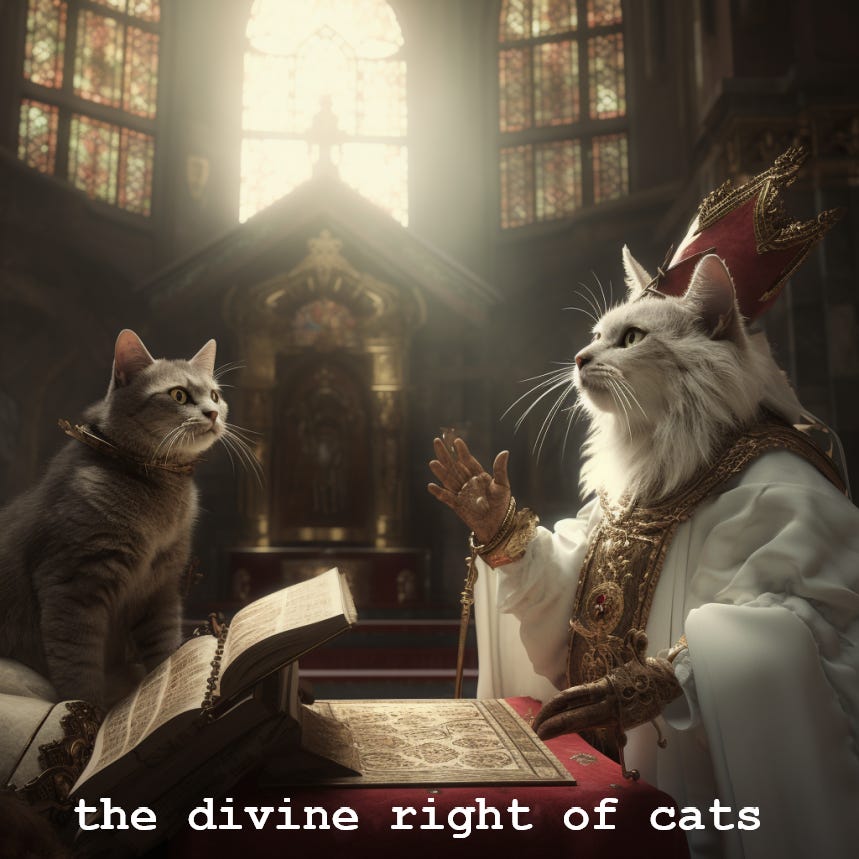
speaking once more as an abject heathen, i have an anthropological intuition that the the acceptance of the idea of monotheism and the prevalence of "there is no god but god/worship none but me/etc" arose as potent unifier and as a sort of emergent protection against cult proliferation to stop just the sort of endless excursion into crazy and harmful/divisive belief sets we see today just as “divine right of kings” was set up and sustained to discourage usurpation. it’s how you keep the effective systems intact and prevent the societal source code from degrading or forking. societal survival is a severe selector for the viability of your organizational structures. and you need to stay on top of this. you let up for 5 minutes and suddenly everyone is worshiping golden calves or pseudoscientific thermometer priesthoods or joining mask and jab cults.
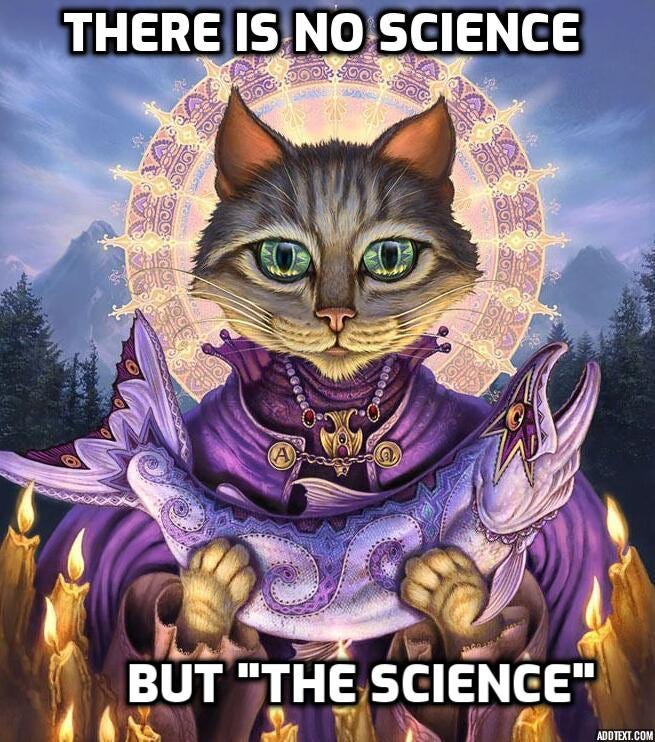
i often wonder if much of the enlightenment was a sort of goldilocks zone where the truly oppressive dogmatic popery of the dark ages attenuated enough to free reason but with sufficient religion remaining to stop the mass proliferation of cults and further suspect that we have now passed outside the zone to the other side and become a bunch of secular theocracies preaching and proselytizing absurdist doctrine from woke to climate doomsday sects to marxism and oppression worship that has been mistaken for "reason” as pernicious parasites populate empty “bigger than me” slots.
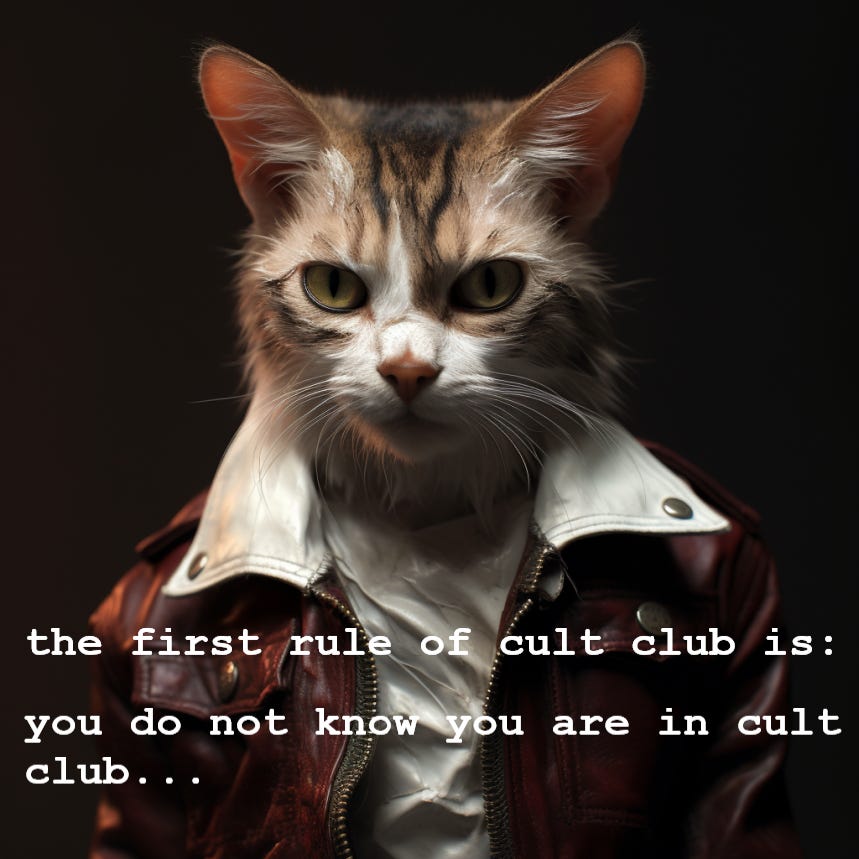
and alas, the first rule of this sort of secular cult club is nearly always "you do not know you've joined cult club."
it's quite literally a derangement of false prophets and grifters preying upon those with insufficient moral and spiritual foundation to defend themselves, a state unfortunately encouraged by much of what is currently passing for “public education.” the empty slots left (or pried) open in their heads by the recession of religious faith are further exacerbated by the demolition and excoriation of society, family, and institutions. the very beliefs that made for a standing society are pulled down and called amoral that other ideas may be placed upon their pedestals. the genetic code of the marxist virus has spread to other vectors and it too wants no allegiance to anything but itself, a jealous “deity” that brooks no straying to other faiths.
they will seek to pull history down and replace it with one of their own fabrication.
and this is where we really go hopelessly wrong.
the unifying stories, parables, and morality of theistic religions and longstanding culture are rooted in the human condition, its needs, its questions. but these cults of purported modernity and progressivism are bleak, inhuman things that do not satiate but rather starve us. they do not fulfill human need but rather drill yawning caverns of entitlement and false moral outrage where one's humanity should be. it's pretty grotesque stuff and about as anti-human as any philosophy can be. it does not ennoble or enlighten, it assaults and the dark ages that will come from this neo-popery of persecution polemic will bring us to the fall of rome 2.0. you can lose decades and centuries to such derangement.
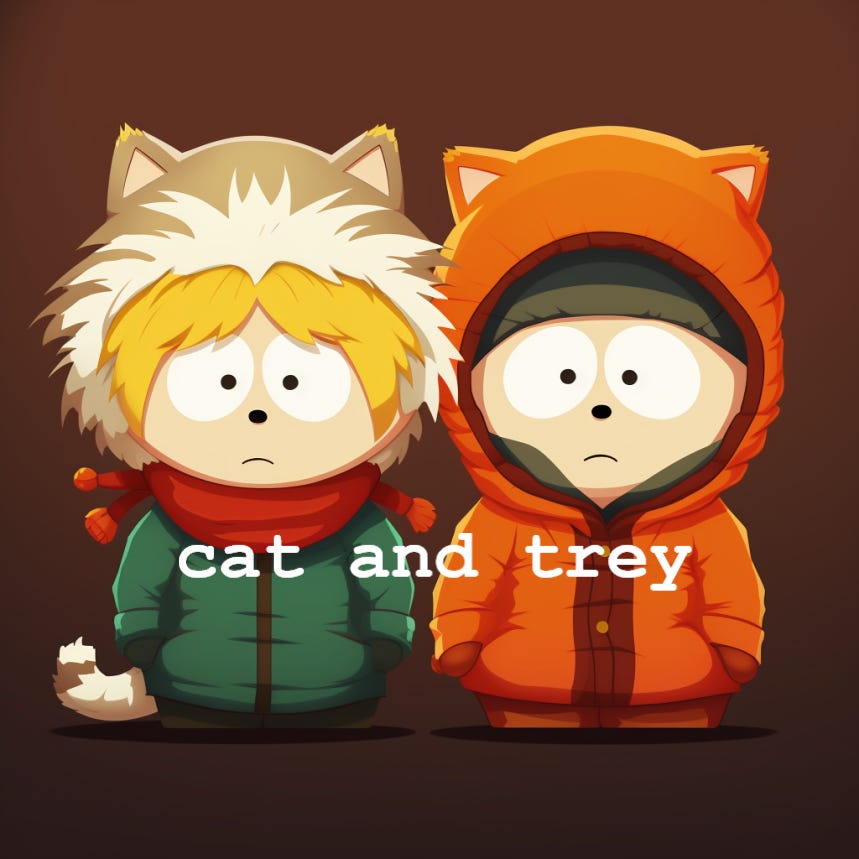
and that is why the art of making fun of these people has become a social and moral duty and prime in the pantheon of righteous ridicule stand nouveau-apostles matt and trey whose southpark has stood for so long as some sort of untouchable and un-cancellable bastion.
like so many things, diversity and inclusion start as laudable ideas and within reason and reasonable bounds are fine enough precepts but like most causes, when the golem gets loose and no one can turn it off, it just keeps digging a hole to the center of the earth and kills us all in its mindless, repetitive stupidity.
it’s also deeply revelatory the manner in which DEI has sought not to add but to efface. diversity should bring new things to the table, but the cults in current currency instead seek to go after our longstanding stories and tales, the fabric of shared society, and the touchstones of commonality. it’s not new tales of plucky new heroes, it’s our tales taken from us and turned against their original form until snow white cannot be white, the dwarves must be eliminated and replaced with unrecognizable soulless “creatures” and the prince is excess to requirements as an avatar of patriarchy . this is not addition, it’s attack. it’s soviet art replacing dostoyevsky.
there is a reason this feels like assault and it’s because it is.
and so we must push back against these aggressive secular sects. what they are peddling is neither progressive nor progress: it’s anti-human discord sown by the damaged and dissolute. we are quite literally fighting to retain civilization and enlightenment from inclusion orcs who took a once good idea much, much too far. and so ridicule shall be our spear and laughter our medicine because not only does this buffoonery lose its power when called by its true name, but we can have a good time doing it. the realization that many are sharing this dream is a powerful thing.
and this sort of lampoon is just devastating. the spectacle of cartman, the angry sociopathic white boy being played by a black woman as she speaks his lines about “explosive diarrhea” becomes unbearably rich in its absurdity and really drives home the ingrained hypocrisy of “diversity” quite literally becoming a form of the colonization it pretends to oppose. note that it always only flows one way: for you can put a “diverse woman” in the role of a historical white male lead, but get a white boy to play “a young harriet tubman” and you’ll have fire and brimstone horizon to horizon.
punch, no punchbacks. our cult is true and valid and needful and it’s OK when WE do it because we are the anointed. heady stuff to get drunk on, but awful to live near if this is not your brand of kool aid.
it is said that it is always darkest right before the dawn and while such claims may be celestially suspect, they seem societally apt. times are changing, cults are being beaten back, and their over-reach into colonization ended by the simple expedient of “people just being sick to death of this and not wanting to participate in (much less pay for) it.
society called and it wants its stories back.
and we shall have them.
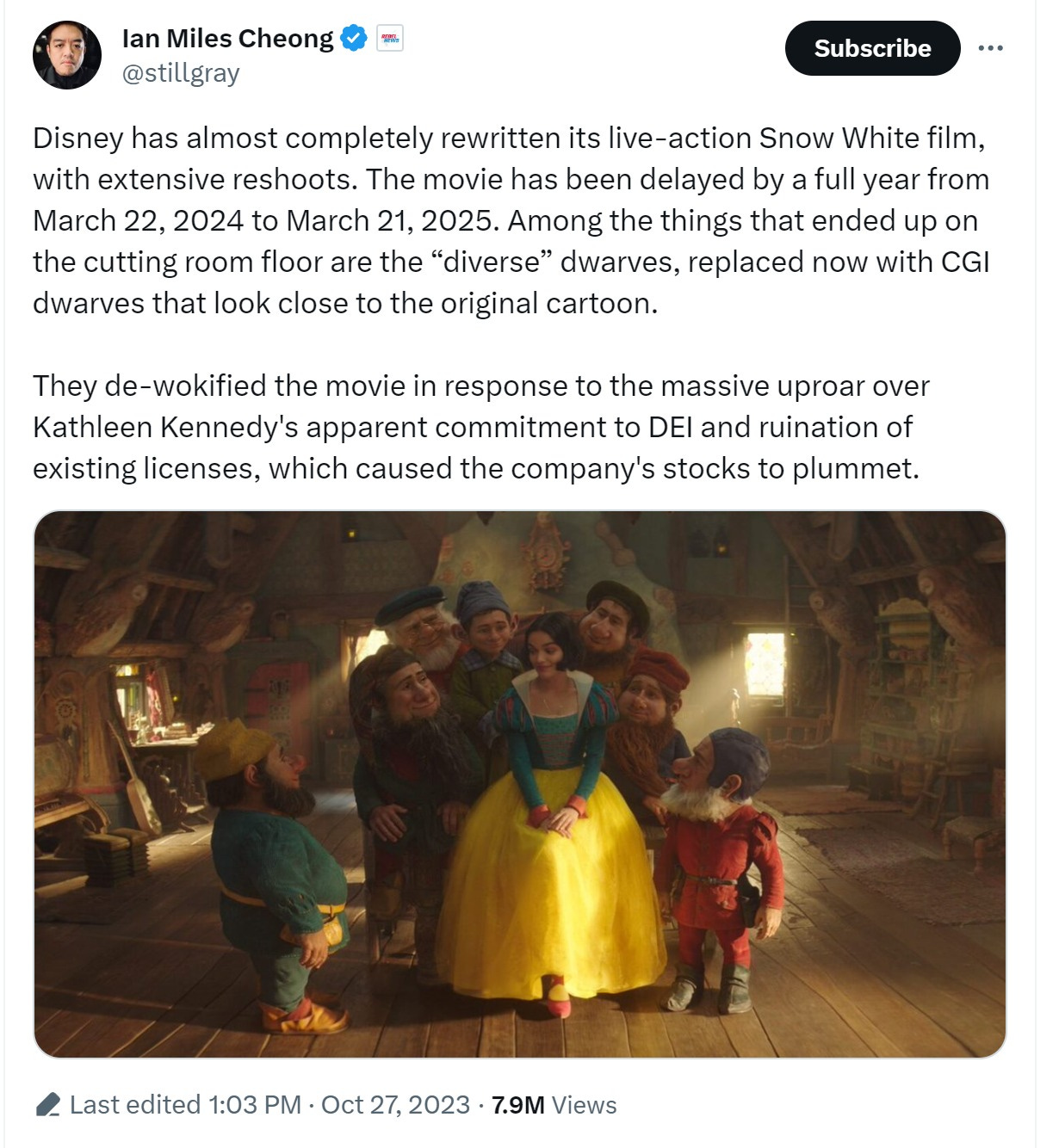
and so as we gird up to dismantle the cults of wokedom and their religious fervor mistaken for rationalism, we stand to regain both our tales and our reason. but what then? those deprogrammed from one cult have a nasty tendency to find another to join. the “place that which is bigger than me here slot” shall once more open in many minds. and we’re going to have to replace it with stories of some kind.
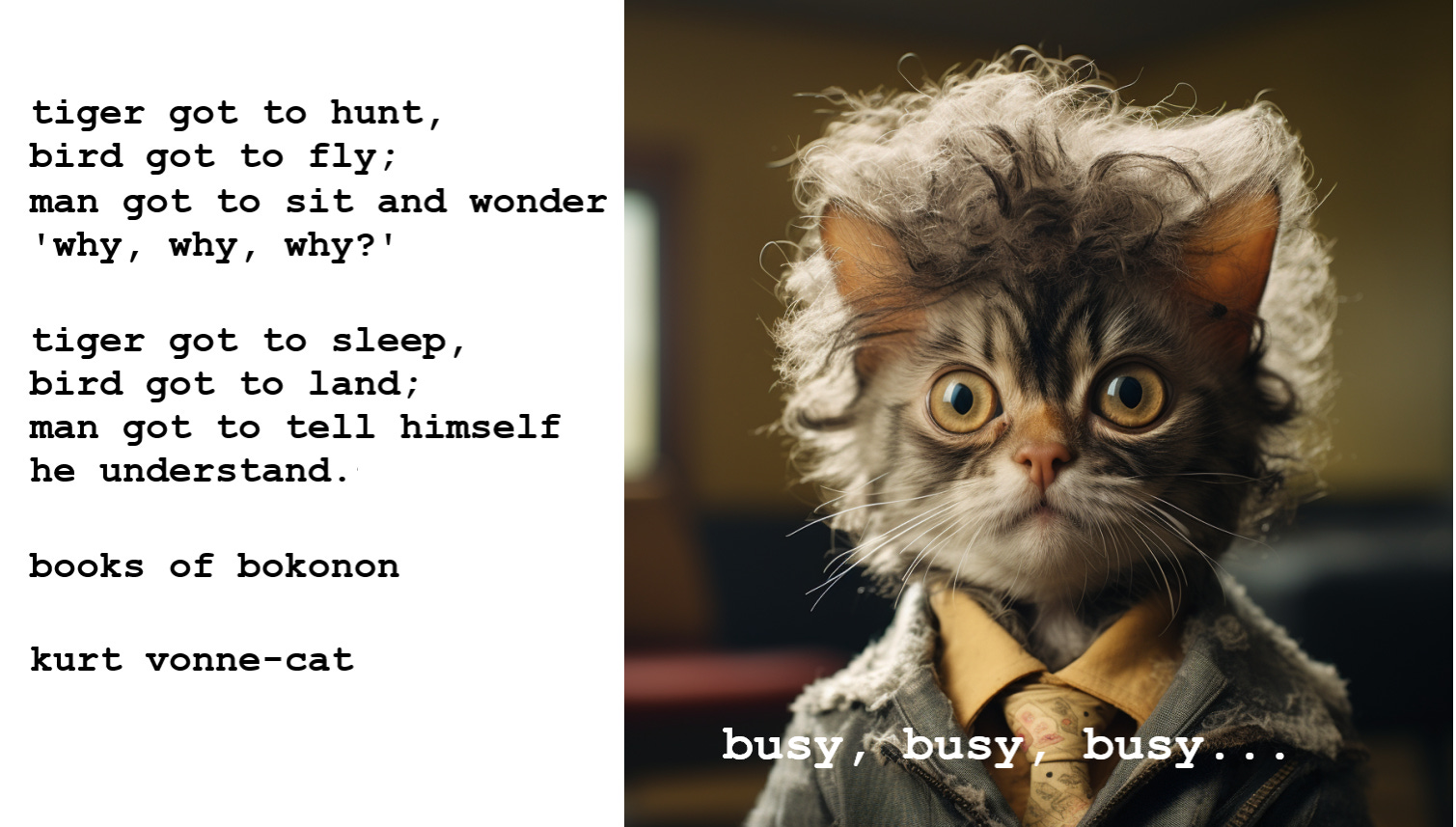
i struggle with the "true vs false" distinction because how may one objectively determine the "truth" of a religion without reference to its own internal tenets? it always winds up in justification by faith. i tend to gravitate more toward the "useful/harmful" or "consistent with human flourishing" vs "predatory and pernicious" axes or perhaps even to vonnegut’s wonderful phrase from “cat’s cradle” in which he admonishes “Anyone unable to understand how useful religion can be founded on lies will not understand this book either.”
do we chose our tales or do they choose us? are they discovered truths or emergent axioms of proven use? does it even matter so long as they work? is a good story simply a good story? perhaps our fairy tales must once more be grimm.
so, as we shake off this new set of cults, what is to become of us? we’re still humans. we’re still wired to require belief in “something bigger than ourselves.” so what’s it going to be?
might southpark lead people back to god? (if so, truly, those are some mysterious ways in which to work)
but what of those not inclined toward theism/deism? can we find sufficient foundation in philosophies of reason and rights akin to galileo and locke? can we find community and society in emergent constructs of our choosing and stories and mores to unify us into a cohesive society capable of sharing a social contract?
it seems this will be the task set to us and perhaps it is part and parcel to the human condition to have to find the road to one’s own humanity. the freedom to scrawl our own designs upon some sort of tablua rasa is both opportunity and responsibility for while it may lift us up it may also allow us to create something that is not in any meaningful way human or even outright monstrous. whatever it may be, it must come from the bottom up, not the top down. it must be our story, our contract, not one force fed to us. it must nourish us. we must inhabit it. who knows, perhaps armed with the knowledge that we need and must seek such stories, we can make intentional the search for our souls.
i do not profess to know the answer, but i certainly do admire the question.
I appreciate your various caveats and respectful tone. I'll just make one comment:
The idea you seem to be ascribing to "justification by faith" appears to be some sort of Kierkegaardian leap as contrasted with empiricism. But when the Bible uses the term "faith" it means "trust" following proof and it is contrasted with works. The religion described in the Bible is an empirical religion grounded in historical acts. God never demanded that people follow him blindly. In fact, whenever he asked for radical trust, he disrupted the natural order to prove himself to his followers. When he came to deliver Israel, he sent Moses with powerful miracles; when he came to oppose the cult of Baal, he sent Elijah; when he said "this is my beloved Son, follow him," he backed the radical claims and ministry of Jesus with many miracles. Of course, we have to trust these claims a little more blindly than those who experienced them, but we have their testimony as a guide; Jesus acknowledged this when he said to doubting Thomas, "you believed because you stuck your fingers into my wounds; blessed are those who will not see and yet believe."
There are answers for those who seek.
I have admired your work these past few years. Thank you.
We all have beliefs, whether we realize it or not. For those whose personal experience is limited to the governance of natural laws, the tendency is to believe that natural laws are immutable (god-like). This is indeed a tenet of what we call modern science, but it cannot be proven. For those who have experienced the presence of God (not just believe because they were told to...) it becomes obvious that God is the immutable entity. This belief also cannot be proven, but is corroborated by the witness of countless throughout human history, and confirmed by continued personal experience.