
what makes labor valuable?
a gatonomics™ lesson


i remain, as ever, in awe of the one-sided zero-move-look-ahead economic illiteracy that has been inculcated into the self-styled american intellectual and social media maven.
it has spilled over into all manner of odd ideas and unrealistic expectation amidst a profound incomprehension about a variety of “trap” industries where there are huge demands for costly education and investment that result in hyper-specialization and options constraint due to both attitudes and opportunities.
architecture is notorious for this. it takes a mountain of school to become an architect, and outside of a few “stars,” the field is mostly a low-wage desperation slog of journeyman work with far too many people chasing too little opportunity.
architect wages stink because the worker has no power. their skills are not scarce, demand for them is limited, their skills do not readily port to other fields, and all want to “do what they studied” often as a sort of passion project (which, of course, is fine to value but often fails to align with monetary incentives.)
your “dream job” in a field you enjoy often comes with a serious price because it’s the dream of others as well. that’s a recipe for oversupply of “prestige” positions and in this absurdist educational cargo cult era for a massive overproduction of workers chasing work that is not in demand while undersupplying industries that are both needful of workers and profitable to work in.
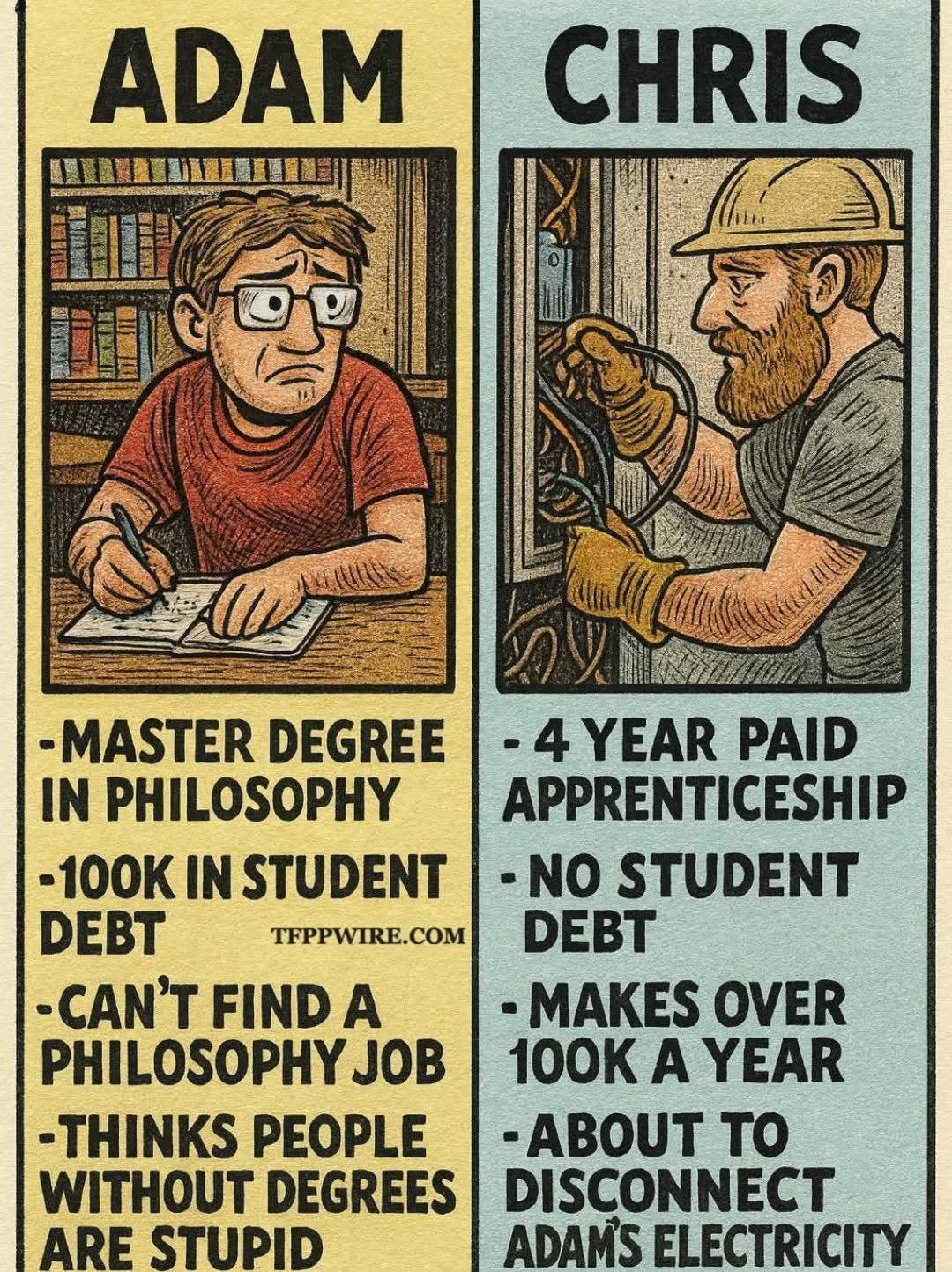
it gets pretty stark.
this sort of issue has proliferated through every industry and “distance work/work from home,” the very thing so many workers think “empowers them,” is, in fact, eating them alive by increasing the potential pool of applicants for every job and flattening wage scales to a level where peoria can supplant new york and “outsource to a programming team in lithuania” looks little different than having a work from home team 2 timezones away in the US in terms of function. but in terms of cost? yeah.
add in AI and a variety of other task automation and this gets really acute. people like to blame “H1B” and, to be sure, that’s a crummy system designed to import indentured CS servants, but i also doubt it has anything like the overall effects people are wont to claim for the simple reason that coding and other similar tasks lend themselves readily to distance work and if we were not bringing the workers here, we’d be sending the work offshore. CS payscales are going global and you really cannot stop it.
the effects in the US are acute.
CS grads with full-time jobs 6 months after graduation fell from 73.2% (2014) to 64.3% (2023). For programming majors: 69% → 50%. Unemployment: 6.1% Underemployed: 16.5%
Half our computer programming graduates are not in full-time jobs within six months of graduation. (source)
“learn to code” did not turn out to be good advice. “learn to be a plumber” did.
this is cascading into every industry.
Oxford Economics report finds employment for 22-27 y.o. college grads in computer science and mathematical occupations is down 8% since 2022: "Recent and experienced college graduate unemployment rates have always been lower than the national average, until now"
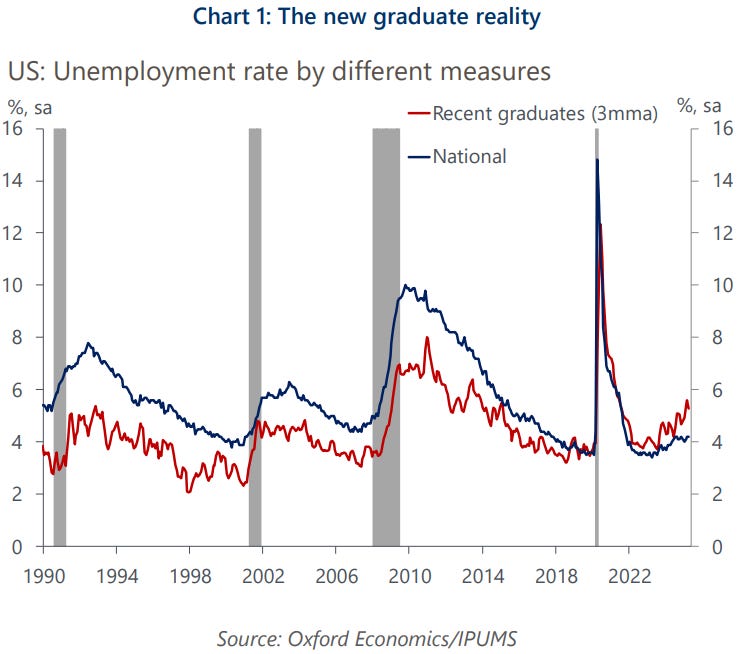
really consider what this means. recent college grads have always had better job prospects than the job market average. since about 2022, they have become markedly worse.
this is telling you two things:
we have too many college grads relative to what the labor market wants
the perceived quality and fit of these grads is not suitable to demand and the market is choosing to hire other forms of worker.
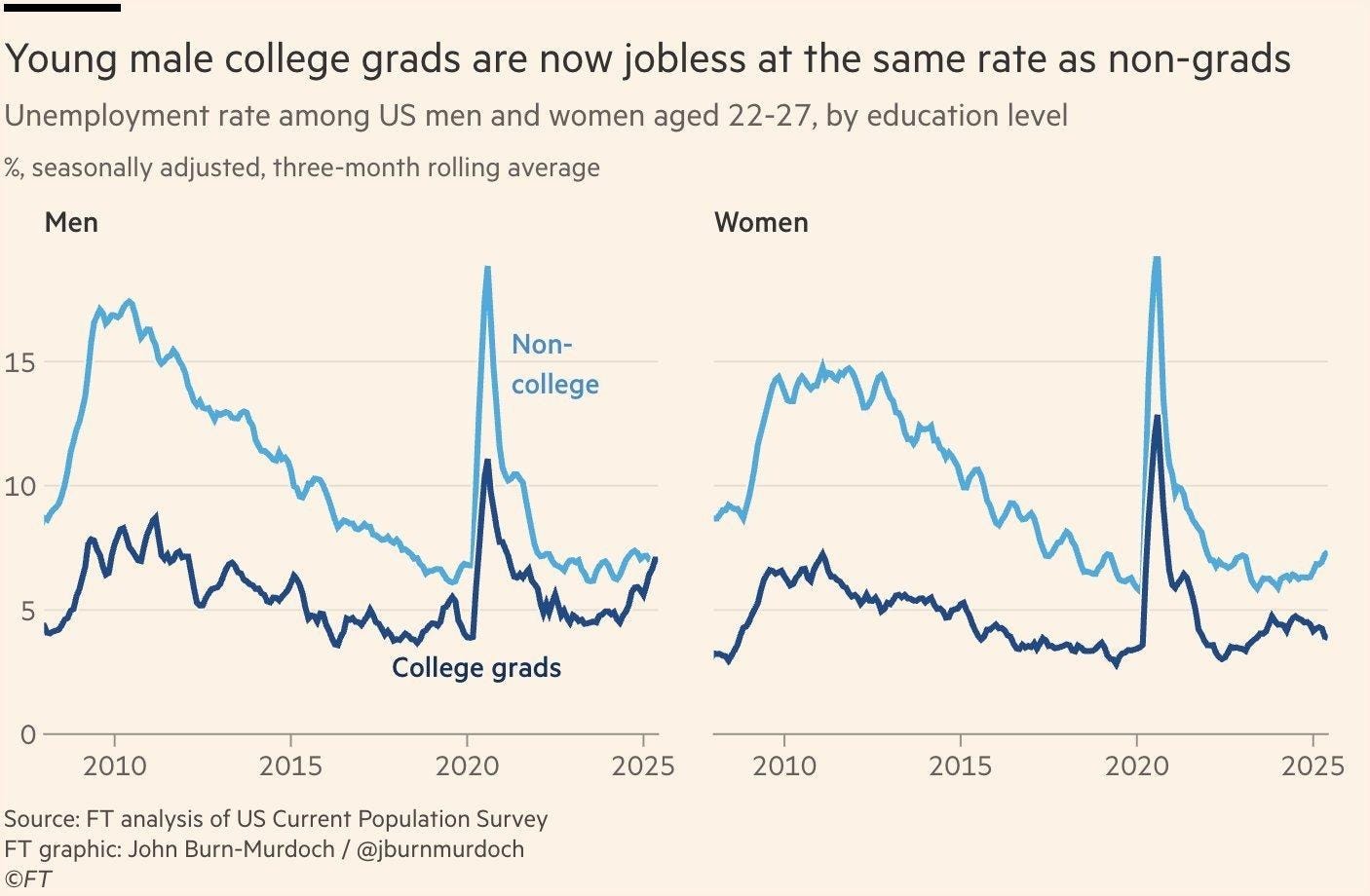
this is hitting young men particularly hard, likely as a bad confluence of DEI and sector shifts that are having the most impact on STEM fields like engineering, programming etc. as well as a number of other “non-college” male fields like skilled trades, contracting, truck driving, etc outperforming.
all advantage on unemployment rate for male college grads vs their non-college peers has disappeared and the level of both is now basically identical and pretty much in line with female unemployment among the non-college educated (slightyl higher but close).
the only real divergence here is college educated women who are exhibiting much lower unemployment rates.
this is not altogether surprising. many studies have shown that women prioritize job security over other aspects like salary and job satisfaction. women are also much more likely to take jobs in healthcare (which has become a female dominated field) and government and those jobs have not been decimated by AI and are less or unsusceptible to offshoring.
but the bottom line here is stark:
college ain’t what it used to be in terms of job opportunities and security. the lake wobegon fallacy of “send half the kids to college and they will all get top 10% jobs” was always an idea destined to failure. mathematics remains undefeated.
the lack of understanding of these basic forces seems to be driving a quite a lot of truly bad takes and demands on wages and labor. “capitalism” is blamed, socialism embraced and all manner of thinly disguised “marxist labot theory of value” notions advanced as entitled explanation for not getting the participation trophy that one was promised.
i’m going to pick on the WNBA here as it’s in the news and provides quite a good object lesson in these concepts.
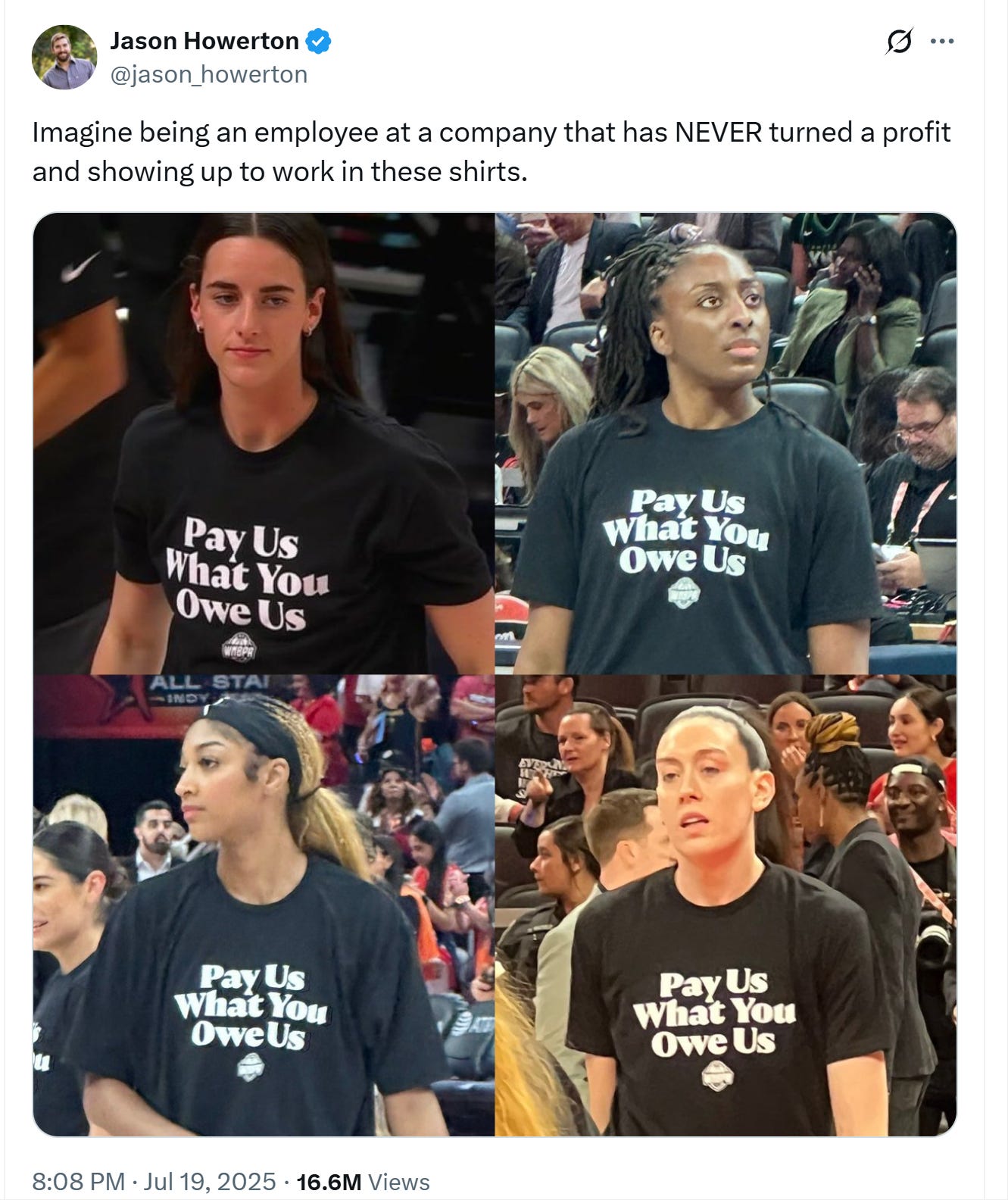
“they need to pay you what you are worth!"
it’s a surprisingly complex statement that carries a lot of nuance that seems to get lost.
i’ll chose this seemingly representative take from ron, “Imagine if the Big Short and High Fidelity had a baby and then that baby joined a Union :)” placone as this lays out the classic “unionist/marxist/labor” take, a take i find to be remarkably one-sided.
first off, he’s starting his assessment of the WNBA in fallacy. obviously, it CAN have those employees. it does have them. they chose to come and work there at an agreed wage.
“pay us what you owe us” seems a deliberate misframing in this regard. they have been paid precisely what they were owed. this is not about owed monies unpaid, it’s about demanding more money in the next contract.
i’m obviously all for people asking to be paid commensurately with what they produce. that’s how markets work (and how they should). you have a set of skills and output you can offer in trade for compensation. the rest is negotiation and leverage.
but this leads rapidly to some questions that ron is not going to like:
well, what are you worth if your only skill is putting on a performance that very few people are willing to pay to see?
not much.
acting and ballet are notoriously savage this way. a few stars that can draw an audience are well paid, the rest exist on a pittance holding down other jobs so they can chase their dream.
off broadway performers earn $794-$1730 a week. being among the absolute best at what you do commands little lucre if what you do is simply not something many consumers will pay for. video kiled the theater star.
just because it’s hard or takes special skills does not mean it’s valuable.
the WNBA produced about $200 million of revenue in 2024 and lost about $40-50 million in so doing.
they are a subsidized, loss-making enterprise kept in business by NBA support and no one is arguing that this is about to change, so the reality here is not quite “pay us what we are worth” so much as “subsidize our losses more heavily.”
this is worth keeping in mind as it has been a traditional blindspot for the US unions who have repeatedly used their power like strangle vines to kill their hosts. minimum wage is never “what the union negotiated” and always “zero because we are no longer a going concern.”
that’s not a constraint one would be wise to ignore.
so what are these WNBA players worth?
labor price is a function of supply and demand and therefore two factors come into play:
first:
what is demand?
how valuable is this employee to the employer? no employer will long survive by paying employees more than they will reasonably generate in profits.
how about supply?
how replacable is this employee? are there 20 or 200 more who could do the job similarly well?
these things interact and create a level of leverage for the two sides.
in this case, the players have virtually none.
most of them have zero name recognition, and even the most famous cannot really put butts in seats or generate profits. outside of caitlin clark, most americans could not even name a WNBA player or even a team.
it’s the topic of jokes.
this brings us back to “you have to pay people what they are worth or you cannot have that employee.”
yup, it’s true. you do. but “what they are worth” is really just a function of
what can they produce for you?
how rare is that ability?
how closely can the next best candidate mirror what this employee does?
right now you have a league that loses money populated by athletes with little or no name recognition which is a key aspect of generating revenue.
they are paid $75,000-$250,000, considerably more than an average american but considerably less than many other professional athletes. so, is that a lot or is it a little?
in the end, the equation is simple:
“professional athlete” is actually an awful job market. what makes it awful is that it’s a highly specialized skill set with very few buyers for your labor.
there is no one else who is going to pay these women to play basketball and there are 50 or 100 women who want every available spot. you have to provide a lot of obvious value to get one.
“what other opportunities does the employee have to sell these skills?” is always a core constraint.
consider men’s professional lacrosse. (source GROK)
Premier Lacrosse League (PLL): The average salary in the PLL, a field lacrosse league, is around $35,000-$50,000 per season, with top players earning up to $60,000-$125,000 annually.
Range: Salaries range from $25,000 for rookies to $125,000 for elite players like Paul Rabi
men’s professional soccer may pay well in other parts of the world, but in the US where far fewer watch it, pay is correspondingly lower.
MLS Range: Salaries vary widely:
Minimum: The MLS minimum salary for players under 25 was $71,401, and for players 25 and older, $94,504 in 2024.
Top Earners: Designated Players (DPs) like Inter Miami’s Lionel Messi earned up to $12-20 million annually, though such salaries are outliers. The median is closer to $250,000-$438,728 for non-DP senior roster players
again, like the WNBA or architecture, there are an awful lot of highly interchangeable employees bucking for a scant few jobs “doing what they love” in a highly specialized field, but MLS is 10X the size of WNBA on revenues, there are many more places an employee could try to go and sell skills (soccer is all over the world and professional teams are more common), and some of the teams manage to make money.
but the reality is that all these athletes from the WNBA to the MLS to pro lacrosse or pro baseball really have very little in the way of “walk away” capability. there are few or possibly no one else hiring their skills. you wanna play professional women’s hoops? this is it. any idea that you have some sort of competitive “next best choice” is non-existant.
so the whole discussion is “what can you do for me and how many other people could pretty much do it too?”
and for most of the WNBA, the answer is “not much” and “loads.”
that’s what happens when you back yourself into a skills corner: the wage you can command is always underpinned by what you could command somewhere else, and if there is nowhere else for you to go, your 5 years of grad school don’t matter: you get paid poorly as an architect because there are too many people who could do the job chasing too few jobs to do.
no industry or profession is magically exempt from this.
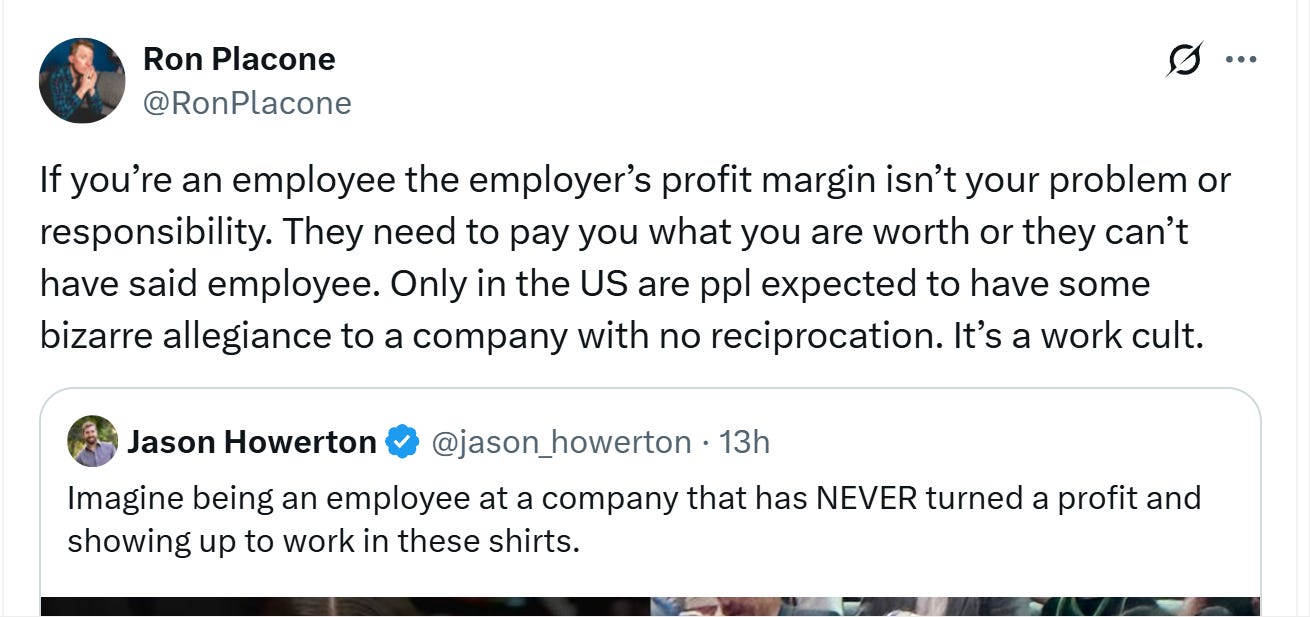
and this brings us back to another or union ron’s takes:
“If you’re an employee the employer’s profit margin isn’t your problem or responsibility.”
because, well, yeah, in the short run perhaps it’s not, but in the long run, it always and inevitably is. it is, quite literally, the pivot upon which industries thrive or die.
in the short run, if you have multiple buyers for your labor, any prospective employer must compete against those in order to successfully secure your work.
but in the long run, if they pay you (and their other employees) more than what you (and they) are worth, the company becomes less likely to survive as a going concern. other companies in the space will out compete and under-price them or other industries will wind up better destinations for and utilizers of talent. that is, quite literally, WHY you need markets and a price mechanism. it’s to sort talent and resources and apply them to the best possible use.
in the short run, i can start an AI entertainment for dogs league and in order to secure good AI programmers, will need to pay the market rate for them because they are in high demand and have lots of other employment options.
in the long run, this market rate is simply too high for me to be able to make money in my chosen market segment. schnausers paying to watch AI frisbee simply cannot support the costs of high demand high skill labor. many, like ron, seek to bemoan such things, but the reality is that it’s an incredible benefit that stops us from wasting time, money, resources, and people on low value ideas like AI for snoopy.
the fact that dogAI failed is the market working. it was a destroyer of value relative to whatever else could have been produced so resources got re-allocated.
it does not compete only against other dog AI, but against all uses of AI just as the WNBA does not compete against “other women’s basketball” but rather against “other things you could watch or attend tonight and other merch you could buy.
it does not seem to fare well in that contest.
such competition is always a moving target, prone to overshooting on both sides and to sudden schumpeterian disruptions of creative destruction.
“learn to code” or “go to college” was once good advice and is increasingly becoming less so even flipping over into a bad idea.
trade schools are thriving because that field overshot the other way as many who might have once trained there instead went to college and studies anthropology. pricing is now telling the market to produce more plumbers and electricians.
will the WNBA ever prove profitable? i doubt it. it seems like an ill-conceived mess thrust to prominence owing more to some dogmatic desire to supply it than any actual demand for it, but who knows? tastes change. perhaps it will become popular. but probably not. the odds on bet would seem to be that surly players and absent audiences familiar with the league more for labor relations than gameplay will prove a poor combo and the league will go the way of the dodo.
the bottom line is that we’re going to see this in industry after industry in ways not previously experienced. the industrial revolution created massive gains in productivity and dramatically reduced the number of people needed to produce food and goods.
this is now moving to professional spheres that, up until now, have been laregly spared.
coders and graphic designers and many others are already under serious pressure.
over the next 5 years, doctors, lawyers, engineers, accountants, and money managers are all going to come into crosshairs and see industries and payscales demolished. there will be a fearsome rear guard fight from guild systems (the bar, medical boards, CPA association etc) but it’s doomed to fail as they are just more unions trying to keep wages too high and prevent progress and increased access. taking humans out of medicine and breaking the cost spiral is the only possible way for the west to survive the already arriving wave of unfunded entitlement, and in the end, needs must will out and fiscal reality will trump guild control.
this is actually going to be amazing for consumers, a drop in price and expansion of availability in professional services that will rival the gains of the industrial revolution. once, making a pair of shoes consumed so many skilled resources as to cost months of wages. a good shirt was so valuable that people willed them to their children. now shirts are so cheap as to constitute less than an hour of most people’s labor. but the cost of “healthcare” has not worked like this despite being a technology product. law and accounting-services remain domains priced like rare gems.
they are about to be disrupted.
many are lamenting this forthcoming employment apocalypse for the over-educated, but we really should not. it will be amazing for the consumer and just like the tractor and the plow and the combine it will allow all manner of new and better innovation increasing standards of living through productivity gains as resources free up and move to profitable application.

my advice to those contemplating school right now is this:
do not assume you need college. it’s a glut and in increasingly over-priced and under quality product.
the market is telling us so.
if you are a top ~10% intellect, perhaps you should go. if not, probably you shouldn’t. the highly specialized fields are going to become cruel education and debt traps for the 50th to 80th percentiles. you’ll be a specialized organism in an ecosystem hostile to you because the low end of these fields is going away rapidly and you’ll be flattened between the hammer of the top 2 deciles of humans and the anvil of schumpeterian technology.
if you are not providing a service locally (or a good that does not face foreign competition) you are going to be competing in a global marketplace. if you are serious best and brightest, that may be fine for you. if you are not, again, debt trap and perennial job insecurity.
get over the “i need to get my diploma and be an elite” idea.”
it’s increasingly a punji pitfall.
you know who does not have that problem? plumbers. electricians. contractors. HVAC repair. and based on the prices i am seeing, every one of those fields has a mountain of available work.
if you want to be middle class and upwardly mobile, remember what that used to be. it was small businesses made up of skilled workers, not a bunch of prim white collar BA’s with clean hands who were too proud to “do manual work.” that’s a recent innovation and a bad one.
the charts don’t lie. we’ve obviously overproduced that sort of worker.
over the course of your life, your careers are likely to change.
but debt is forever.
cultivate flexibility and useful skills for which there are many buyers and unless you are truly an elite producer, avoid fields with monopsony (one buyer for a good) like the WNBA.
you absolutely “need to care about P and L.”
that’s what will ensure that you’re in a company and a space with a future.
the game is changing (as it always has and always will) and the change will ultimately be good for all of us, the young most of all.
but it seems to me like a lot of unfortunate advice is being given out to fight the last war instead of this one as educational maginot lines are circumvented and rendered futile wastes of resources.
if you’re young and want to thrive, step back and look with clear, new eyes.
if you want your labor to be valuable, it’s this simple:
you want many buyers for it,
few competitors (including technology) to provide what you do,
and real value creation.
if that seems like “55th percentile humanities degree” to you right now, you’re likely in trouble…

The WNBA will be fine. They're going to increase demand by shaming us into watching it. If that doesn't work they'll pass laws that we have to watch it. It will be part of your phone and Internet package; no WNBA, no phone. Great, great business model.
If there's one work I could make required reading for American voters, it would be Thomas Sowell's 'Basic Economics'.
https://jmpolemic.substack.com/p/documented-facts