
generational wealth
assessing gens Y and Z and their claims to have it tougher than those before

the matter of gen Y (the millennials 1981-96) and gen Z (1997-2012) and their sense of disenfranchisement from economic opportunity seems to be the driving narrative of the moment, and honestly, the whole thing has struck me as a little too pat and precious to take at face value.
i started niggling at this the other day when looking at home affordability and rapidly discovered that, as recently as 2021-2022, homes were at generational levels of maximum affordability. it’s only in the last couple years that this changed. this punches a meaningful hole in the “our generation has never had a shot to buy a home” narrative. mostly, they did and likely they will soon be able to do so again.
but what of the rest of it? what about the “you used to be able to have one earner and raise a family and we don’t earn anything like what our parents and grandparents did, it’s so much harder now, so expensive, you guys have no idea what it’s like!” refrain that has become so common? is this real or just another example of “how we know what isn’t so”?
it seems a matter worth getting to the bottom of, because it’s certainly gaining common currency and it’s being used to drive a generation to socialism and to stir up distrust and antipathy toward free markets and capitalism.
this seems a common sort of current messaging:
and frankly, it’s just mostly wrong.
houses were not $125k, the average was $160-180k which is $307-$345k in today’s dollars. an average home today is $512k, so more expensive but it’s also considerably bigger.
mortgages were 6.9% then and stand at 6.1% today (5.3% if you’ll do a 15 year) with far more lenient money-down provisions.
so, yes, housing is more expensive, but not by as much as claimed and really only in the last 3 years.
an average new car was about $20k in 1998, but that’s $38k in current dollars which is plenty of money to buy one of dozens of really good cars that are WAY better than anything on sale in 1998 in terms of reliability, longevity, features, etc. you’re into a loaded accord for $29k. and buying new does not matter much anymore when you can put 200k miles on pretty much anything.
gas is more expensive, but mileage in cars is also way better.
so $1.03 = $1.98 in current dollars and you get 37 mpg vs 27 which gets you to an effective price of $2.71 which is pretty comparable to the $3.07 right now.
that rent figure is just made up. average rent for a 1br was $1040 in the US in 1998 and where i lived, in SF, we were paying multiples of that. i was paying around $1000 for one bedroom in a 2 bedroom apartment with a converted dining room and a small maid’s quarters that 4 of us were sharing. having multiple roommates and still spending 25-33% of your income on rent was normal and expected. we all did it. “getting your own place” was a late 20’s thing if you were doing well. it often meant 40%+ of income going to housing. many did not manage it.
a CD for $14 ($27 in today’s dollars) meant that for the price of infinite spotify you could buy about 1 CD a quarter.
food may have been $40/wk and be $90 now, but again, $40 is $77 in today’s money and the bigger question is “what are you buying?” it’s easy to buy cheap food, but add a few “luxuries” and you run up the bill. same goes for “eating out.”
so, some things may legitimately be more expensive even in real terms (though others like cars and music are much cheaper)
but:
a lot of the “higher price” is upward skew from high-spending boomers who have a lifetime of capital accumulated and can be mitigated by not seeking to buy the mercedes and porsches they drive or the huge homes they inhabit or the foods they eat. that’s not how “starting out” used to work.
salaries are also much higher.
median personal income has exploded since 1998.
it was $45,140 in 2024 vs $19,950 in 1998. that’s a 126% increase.
even adjusted for inflation, median personal income has just about doubled since 1982.
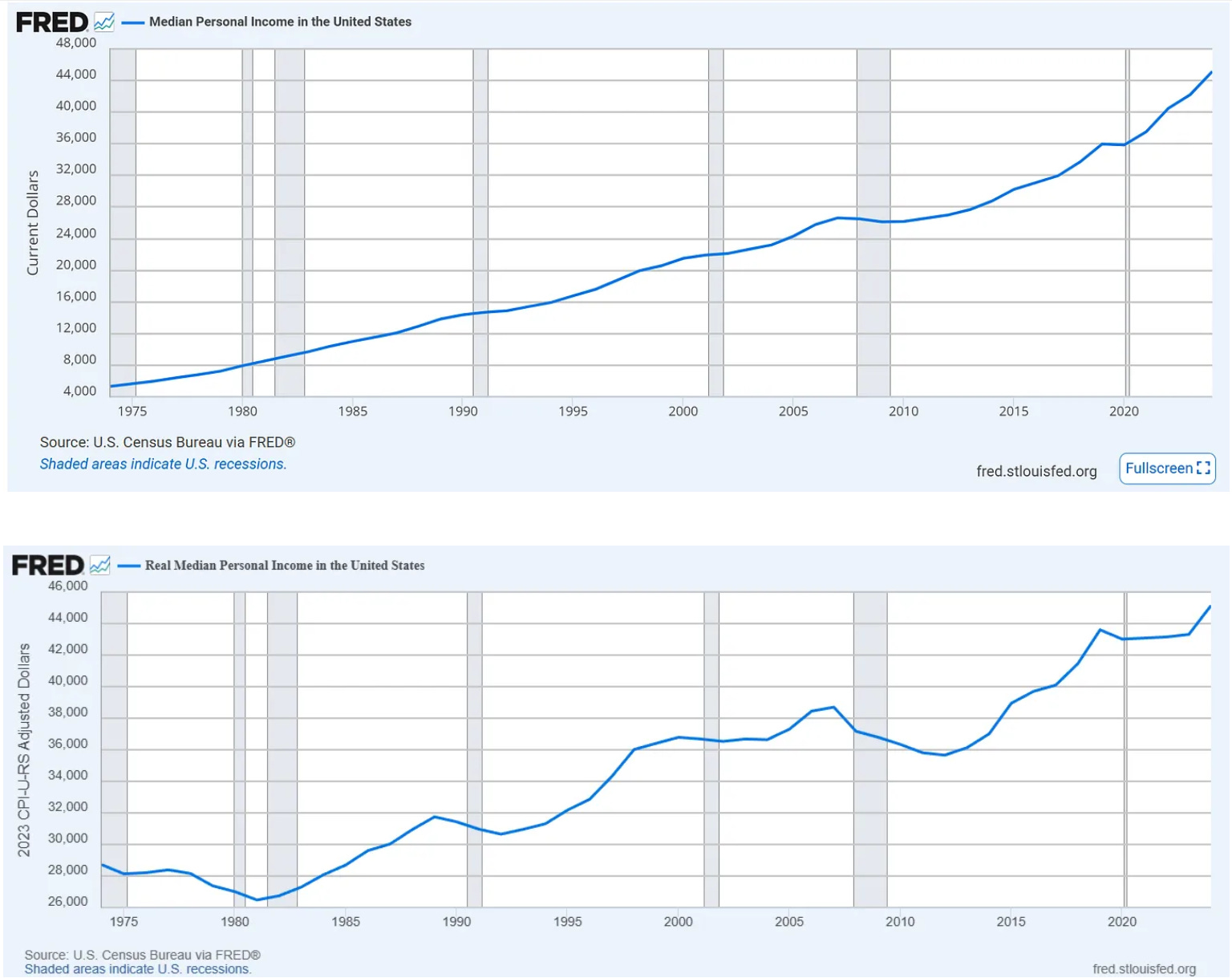
and that starts to make claims like this look questionable.
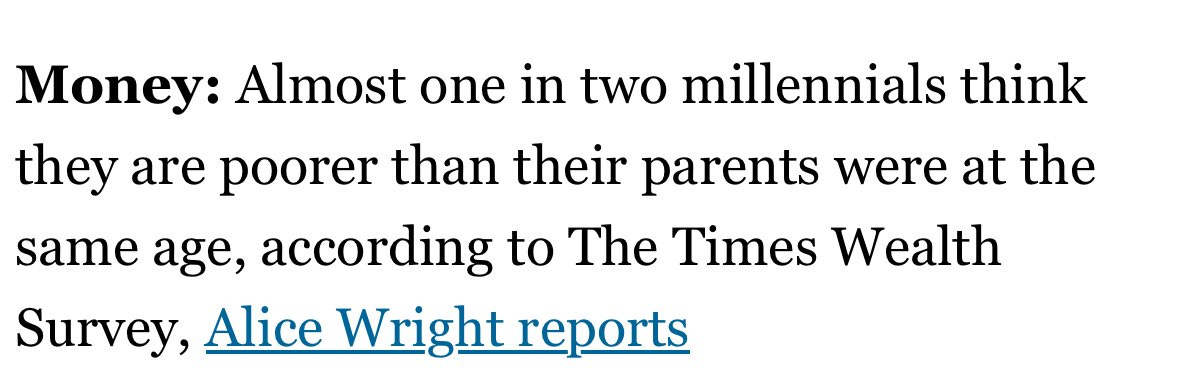
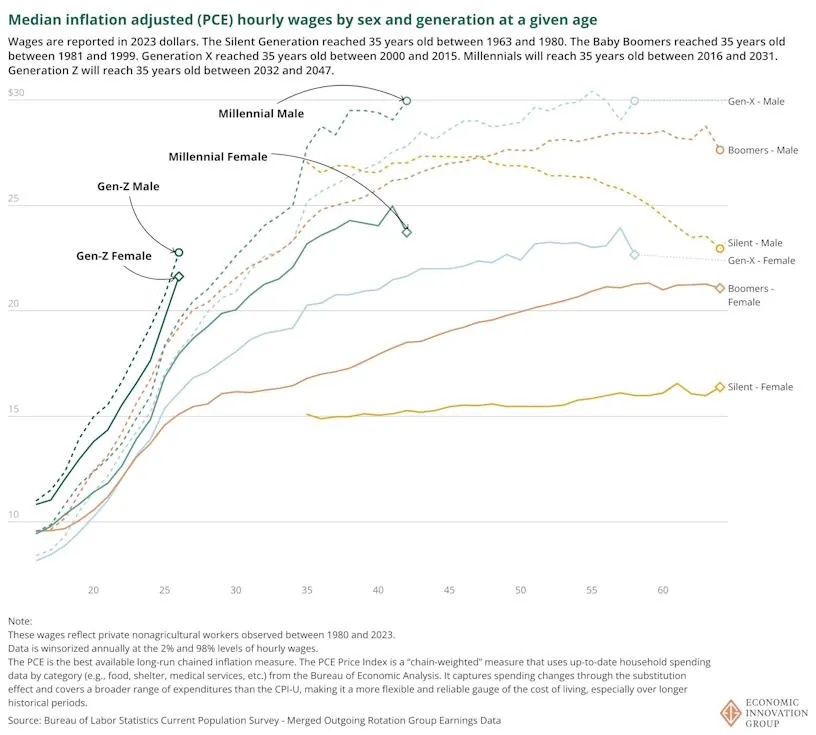
one could certainly seek to argue that “the median income is irrelevant to these young generations and being pulled up by boomers and gen X” but this claim fails to hold water.
it turns out that, age for age, millennials are earning more on an inflation-adjusted basis than boomers or gen X and that gen Z is on a pace to far exceed them.
by 32, millennial males exceeded peak boomer male earnings and by 42 hit peak gen X.
they are about to be the highest earning folks ever.
millennial females are so far ahead of prior generations it’s hardly comparable.
and gen Z is blowing gen Y away.
(note that unlike gen Z and most of gen Y, gen X actually lagged behind the boomers on earnings until we hit our mid 30’s. unlike the kids today, we actually did have it harder.)
(source)
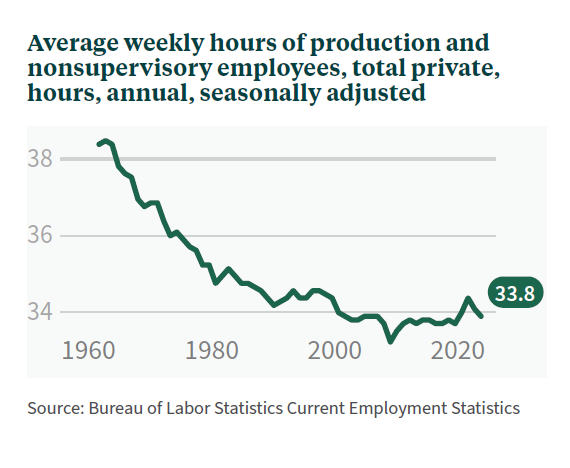
it’s interesting that people are working fewer hours (likely because they can afford to) but this has been pretty flat for 25 years.
but as one can see from this study done by the economist, it’s not reducing overall income or making the rising generations poor compared to past ones. in inflation adjusted terms, these groups are massively outperforming other generations year for year.
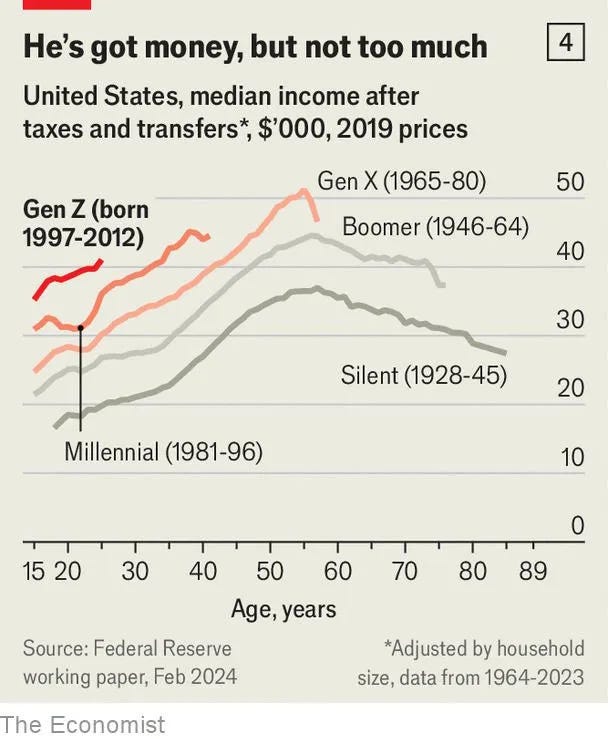
people likely feel stressed because everyone excpet gen Z got hit in real terms the last few years. gen X got hit especially hard by the loss of earnings to inflation.
we also did worst in the times covidian in terms of wealth generation while the young outperformed dramatically.
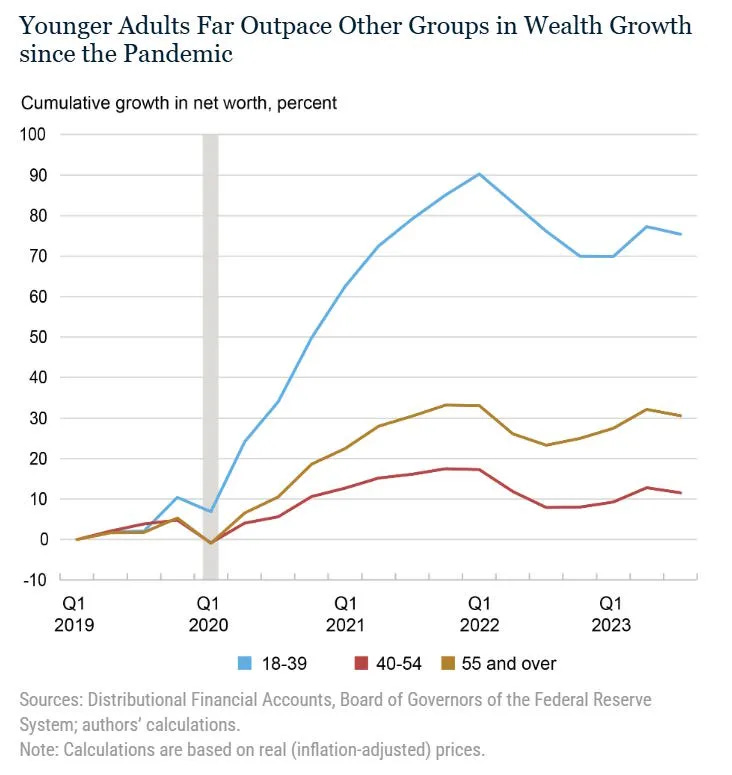
rate of return can be misleading as going from $10 to $20 reads as 100% and is clearly less attractive than going from $100,000 to $150,000 even though that’s only 50%, but the aggregates show this same story and in absolute terms, gens Y and Z have more than twice as much inflation-adjusted wealth at age 31 as gen X did.
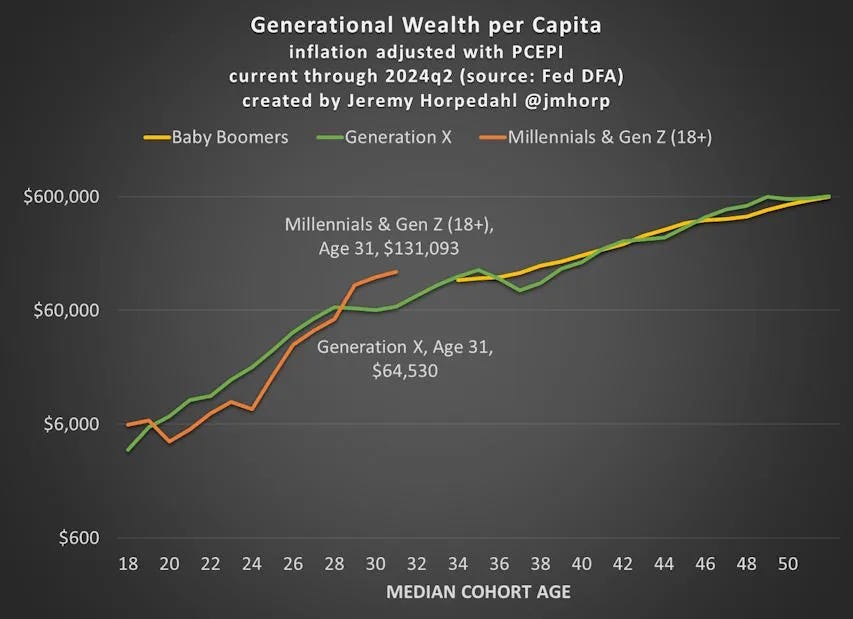
there’s basically no other way to slice it:
yes, things are a bit more expensive now, but this generation can more than afford it.
in inflation-adjusted terms, they earn more and have more saved wealth age for age than any other generation in history.
so what’s all the fuss about?
it’s tempting to just post this video and be done with it. (also a very gen X thing to do)
and there’s likely some truth to it, but i think there’s some deeper truth and issue here:
gens Y and Z are different from any previous US generations in a couple of ways:
they grew up wealthy with rich boomer and gen X parents
they grew up digital in the overly big room of the internet and continue to live and benchmark themselves there
this matters a lot because people perceive well-being in relative, not absolute terms and they often tell themselves inaccurate stories in pursuit of such.
a 25 year old zoomer kid raised in a big house with luxury cars and lavish vacations experiences an income 28% higher in real terms than gen X had at that age as deprivation in a way that gen X did not. we were not used to those things and so moving into a dump with a bunch of roommates seemed normal. not being able to afford to eat out seemed normal. no one even considered buying a new car in their 20’s. (hell, i’ve still never bought one. i could, but why? you can save 50% by buying a 2 year old car with low miles returned off a lease and given cars today, it’ll last you forever.) vacations in my 20’s were “driving to my parents house to ski” or maybe “flying to NYC to crash with friends.” intragram bali trips were not even conceiveable.
we did not drop money on designer candles. our furniture was junk.
it seems like the kids today just don’t get this. they assume the older generations lived and spend like they do. but we didn’t.
we “afforded a house” by buying in crappy areas and fixing stuff up. we saved up.
generation “3 vacations a year, eat out every day” was just not a thing.
and this gets hideously inflamed by the internet full of children of outlandish privilege flaunting jets and sportscars and outfits that cost as much as a year of ivy league tuition.
it’s breaking people’s brains.
these numbers are hallucinatory, even for gen’s X and Y, but Z has completely lost the plot.
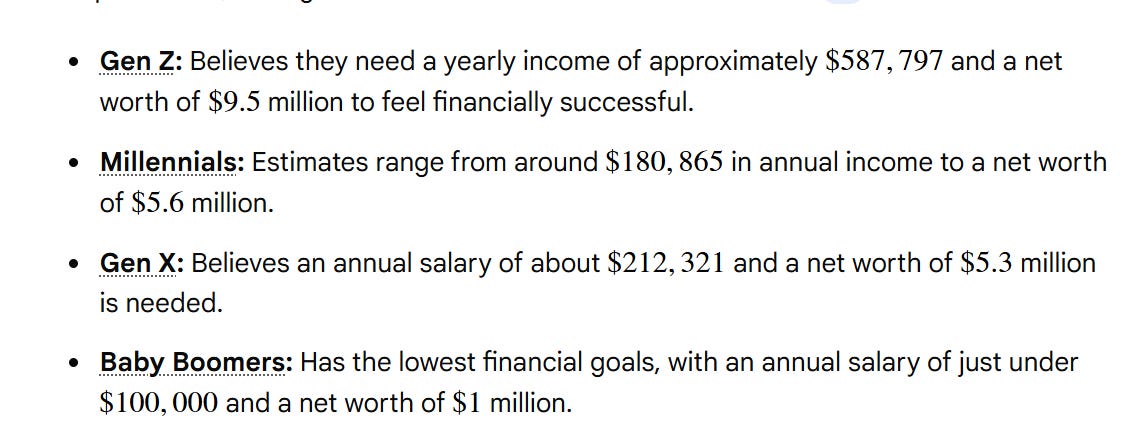
$212k is a 95th percentile US income.
the 99th percentile is $450k so gen Z now thinks you need to be 30% above the cutoff that only 1 in 100 reach “feel financially successful.”
$9.5 million is above 98th percentile US wealth.
for all but the most extreme cases of success, these are not attainable goals.
it means that statistically speaking over 99% of them are going to feel like failures.
sorry, but that’s not a failure of capitalism, it’s a failure of perspective.
most of what’s going on here is a sort of subjective financial hypochondria, a set of self-deluding self-pity rooted in having to step down in lifestyle from the wealthy homes they left and getting bombarded with tales of times that never were. they assume that “the boomers and gen X” lived like they do and then demand to live only in nice neighborhoods in expensive cities and drink $11 fair trade mocha-ganic chai lattes as they grow ever more envious of the rich brats of instagram.
this has the potential to become a dangerous political trend and i suspect those carefully cultivating it know this full well.
this is a sort of oliver twist pyop being inflicted on the young for political purpose.
if you can convince the generations that have it better than any other in american history that “the system is not working for them” then you can convince them to start voting for systems that well and truly will not work for them (cough, cough, mamdani, cough) and will make their persecution fantasies come true.
then, of course, you blame capitalism again and tighten the yoke further.
this is an idea to keep an eye on and a set of propaganda points that need to be refuted.
having gen Y and Z fall for this is not going to do anyone (apart from the socialist grievance grubbers) any good, least of all gens Y and Z.
mistaking plenty for poverty is a very expensive catergory error both financially and emotionally.
and it’s the last luxury belief you’ll be able to afford.

I compare this with my Grandmother. Only got school thru about the 8th grade. Married at age 15 to the love of her life, a 30 year old. One step-child and three natural children and pregnant when she lost her husband to pneumonia he caught saving people during a flood. Widowed, now with five children and trying to run her husband’s business, which she lost in the Great Depression. Goes to work for someone else for a while. Restarts the family business in her mid 20s. Raises all five children to adulthood. Sends three of them off to war in WWII. Told that her eldest is MIA and presumed dead. Gets the telegram. Turns out he’s just wounded. She gets his letter a few days later. After that, the fourth son is drafted for the Korean War. She runs the family store 6 days a week well into her 90s. Taught all the grandkids to read before they went to grade school. And the complaint is that the current bunch of 20-30 year olds have it rough. Try being married at 15 and widowed before you’re 21. Trying being a single mother in your 20s with five kids in the Great Depression. Try sending four of your five children to war, not knowing if you will ever see them again.
" . . . adjusted for inflation, median personal income has just about doubled since 1982."
I am a typical Boomer. We bought our first house + .4 acre in about 1982 for $53,300. That same house would now cost $450,000 or more. So, salaries have not kept pace -- even doubled. This is the result of an out of control federal government aided by a compliant Federal Reserve. This accelerated during the Covid fiasco when trillion$ were created out of thin air.